
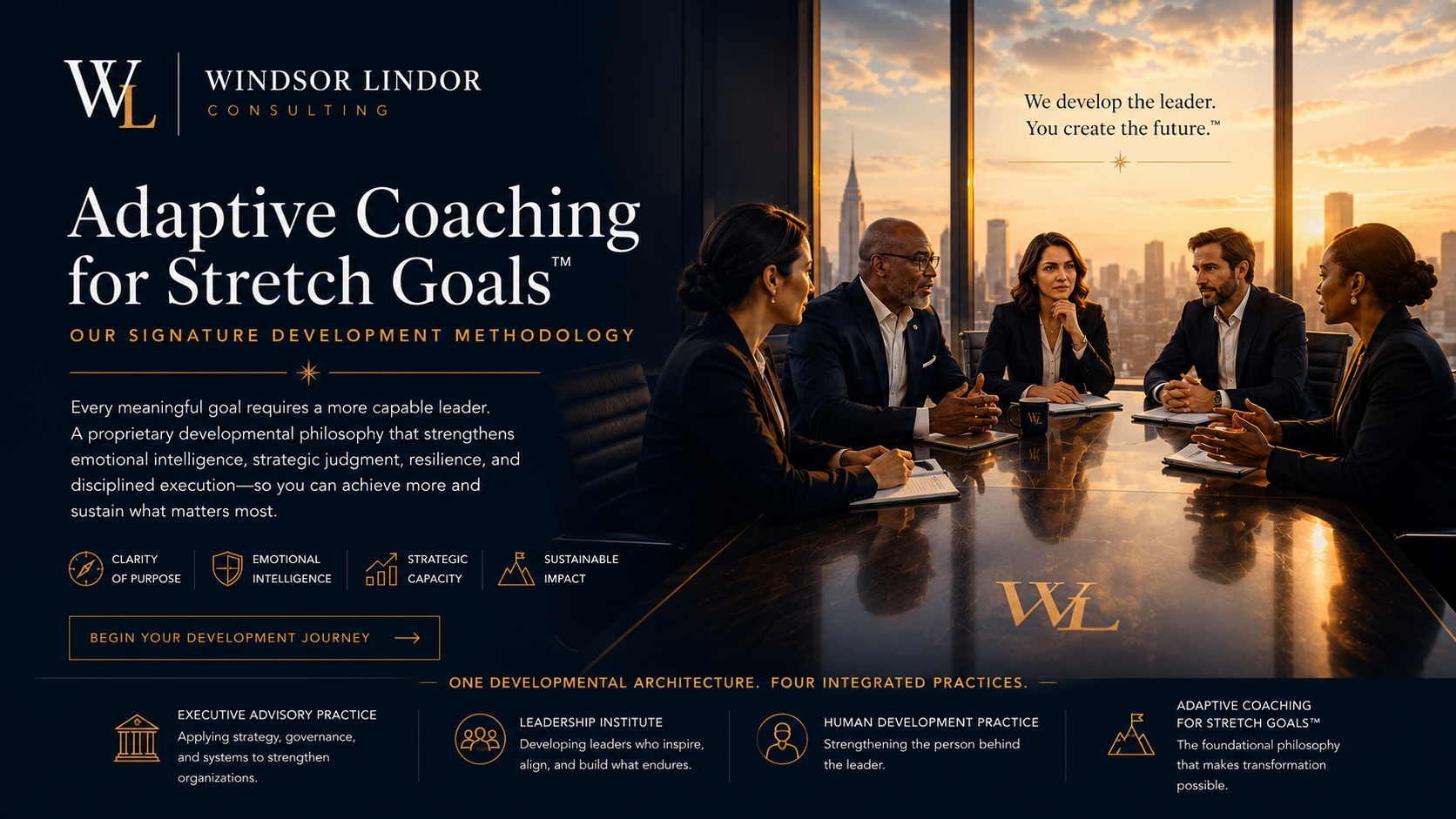
Building What Endures
The Foundational Developmental Philosophy of Windsor Lindor Consulting
Every Meaningful Goal Requires a More Capable Person.
The future is not created by ambition alone.
It is created by the continual development of the person entrusted to carry that ambition.
Every meaningful aspiration—leading an organization, building a business, strengthening a relationship, serving a community, or intentionally creating a Brand New Life—requires more than knowledge, determination, or technical expertise. It requires growth in character, emotional intelligence, strategic judgment, resilience, and purposeful action.
Adaptive Coaching for Stretch Goals™ is the foundational developmental philosophy of Windsor Lindor Consulting.
More than a coaching methodology, it is the intellectual framework that unifies every advisory engagement, leadership experience, coaching relationship, publication, and future contribution of the firm.
Rather than asking, "How do I accomplish a bigger goal?" we begin with a deeper question:
Who must I become to sustainably create the future I seek?
This philosophy shapes every engagement because lasting transformation begins with the invisible architecture that influences every visible result.
Leadership is the visible evidence of an invisible architecture™.
Why Adaptive Coaching Exists
Sustainable Achievement Begins with Sustainable Development
Most developmental models focus on improving performance.
Adaptive Coaching for Stretch Goals™ focuses on strengthening capacity.
Performance may fluctuate.
Capacity continues to expand.
As responsibilities grow, leaders inevitably encounter greater complexity. Decisions become more consequential. Relationships require greater maturity. Organizations demand clearer thinking. Life itself asks for greater wisdom.
Stretch goals expose these developmental gaps.
Rather than treating them as obstacles, Adaptive Coaching views them as invitations to become more capable.
Growth therefore becomes intentional rather than accidental.
Achievement becomes sustainable rather than temporary.
Success becomes the natural expression of a stronger inner architecture.
Our Developmental Philosophy
Capacity Before Achievement
Every meaningful outcome is supported by invisible conditions.
Before organizations flourish, leadership must mature.
Before leadership matures, individuals must develop.
Adaptive Coaching strengthens the capacities that quietly influence every meaningful result:
Awareness before action
Character before credibility
Emotional intelligence before influence
Responsibility before authority
Stewardship before success
Systems before scale
Reflection before reaction
Discipline before performance
These principles form the developmental foundation of Culture of Success™, Strategic Self-Leadership™, Systems-Aligned Leadership™, and Organizational Stewardship™.
The objective is not simply to accomplish more.
It is to become someone capable of sustaining more.
The A.S.C.E.N.D.™ Framework
A Practical Pathway for Meaningful Growth
Adaptive Coaching for Stretch Goals™ is organized through the proprietary A.S.C.E.N.D.™ Framework, providing a practical developmental pathway for leaders pursuing ambitious outcomes.
Align
Clarify purpose, values, priorities, and the future you intend to create.
Stabilize
Strengthen emotional intelligence, resilience, healthy habits, and the internal conditions required for sustainable growth.
Clarify
Develop strategic thinking, executive judgment, self-awareness, communication, and thoughtful decision-making.
Expand
Increase leadership capacity, confidence, adaptability, creativity, and perspective.
Navigate
Lead effectively through uncertainty, transition, setbacks, opportunity, and increasing complexity.
Deliver
Execute consistently with accountability, operational excellence, disciplined action, and long-term stewardship.
Every stage prepares leaders not only to achieve greater outcomes, but to become capable of sustaining them.
One Developmental Architecture.
Adaptive Coaching for Stretch Goals™ serves as the connective philosophy across every Windsor Lindor Consulting practice.
Executive Advisory Practice
Applying Adaptive Coaching to organizations by strengthening governance, strategy, systems alignment, organizational culture, stewardship, and sustainable execution.
Windsor Lindor Leadership Institute
Applying Adaptive Coaching to leaders by cultivating emotionally intelligent, values-centered leadership that strengthens trust, accountability, communication, and organizational performance.
Human Development Practice
Applying Adaptive Coaching to executives, entrepreneurs, professionals, couples, and individuals through Executive & Life Coaching, strengthening emotional intelligence, resilience, executive presence, purposeful relationships, and authentic fulfillment.
Adaptive Coaching for Stretch Goals™
Providing the enduring developmental philosophy that explains how meaningful transformation occurs across people, leaders, organizations, and communities.
Together, these practices form one coherent philosophy dedicated to leadership, organizational stewardship, and human flourishing.
One Philosophy. Four Integrated Practices.
An Evolving Body of Work
Designed to Grow Across Generations
Adaptive Coaching for Stretch Goals™ is intentionally designed as a living body of intellectual property.
As Windsor Lindor Consulting continues to evolve, this philosophy will expand through:
Workbooks
Executive journals
Guided workbooks
Leadership assessments
Reflective practice guides
Executive cohorts
Leadership academies
Facilitator guides
Organizational implementation tools
Research publications
Articles, lectures, and podcasts
Each new expression extends the same developmental philosophy while making it accessible to leaders, organizations, and communities around the world.
Continue Learning
Development Is a Lifelong Practice
Adaptive Coaching for Stretch Goals™ is supported by an expanding ecosystem of learning resources designed to reinforce growth beyond every coaching engagement.
Continue exploring through:
Executive Advisory Practice
Windsor Lindor Leadership Institute
Human Development Practice
Leadership Articles
Executive Lectures
Podcasts
Reflective Journals
WindsorLindor.com
Growth is never finished.
Every stretch goal invites another season of becoming.
Begin the Journey
Become More Than Your Goals Require
Whether you are strengthening an organization, preparing for greater leadership responsibility, intentionally creating a Brand New Life, or pursuing your most ambitious aspirations, Adaptive Coaching for Stretch Goals™ provides a disciplined developmental pathway for expanding the capacity required to sustain meaningful success.
Your future will always ask something new of you.
Transform Potential Into Purpose™
Expand Your Capacity. Elevate Your Leadership. Build What Endures.
Frequently Asked Questions
-
A: Adaptive coaching is a leadership development approach that helps individuals pursue ambitious goals while continuously adjusting their thinking, behavior, and strategy through learning, reflection, and real-time adaptation.
-
A: A.S.C.E.N.D.™ stands for Adaptive Strategy for Capacity, Execution, Navigation, and Development.
The framework moves through six leadership practices:
Align. Stabilize. Clarify. Expand. Navigate. Deliver.
How is this different from traditional goal-setting?
Traditional goal-setting often focuses on targets, timelines, accountability, and execution. Adaptive Coaching includes those elements while also developing the leader’s internal capacity, emotional intelligence, decision-making, and identity.
Stretch goals are rarely achieved by doing more of the same. They require a more adaptive leader.
-
A: This work is best suited for executives, founders, CEOs, company principals, business owners, senior professionals, and purpose-driven leaders navigating complexity, growth, transition, or ambitious outcomes that require expanded capability.
-
A: Clients can expect greater strategic clarity, stronger decision-making, improved emotional intelligence under pressure, more disciplined execution, expanded leadership presence, and sustainable performance structures.
-
A: This work integrates both.
It includes coaching for self-governance, leadership identity, emotional intelligence, and capacity development. It also includes strategic advising around goals, decisions, execution, accountability, and sustainable performance.
-
A: The three-year vision provides a practical leadership horizon. It helps the leader clarify the future, define what must change, identify what must be developed, and translate long-term ambition into weekly movement, quarterly review, and ninety-day execution.