
Executive & Life Coaching
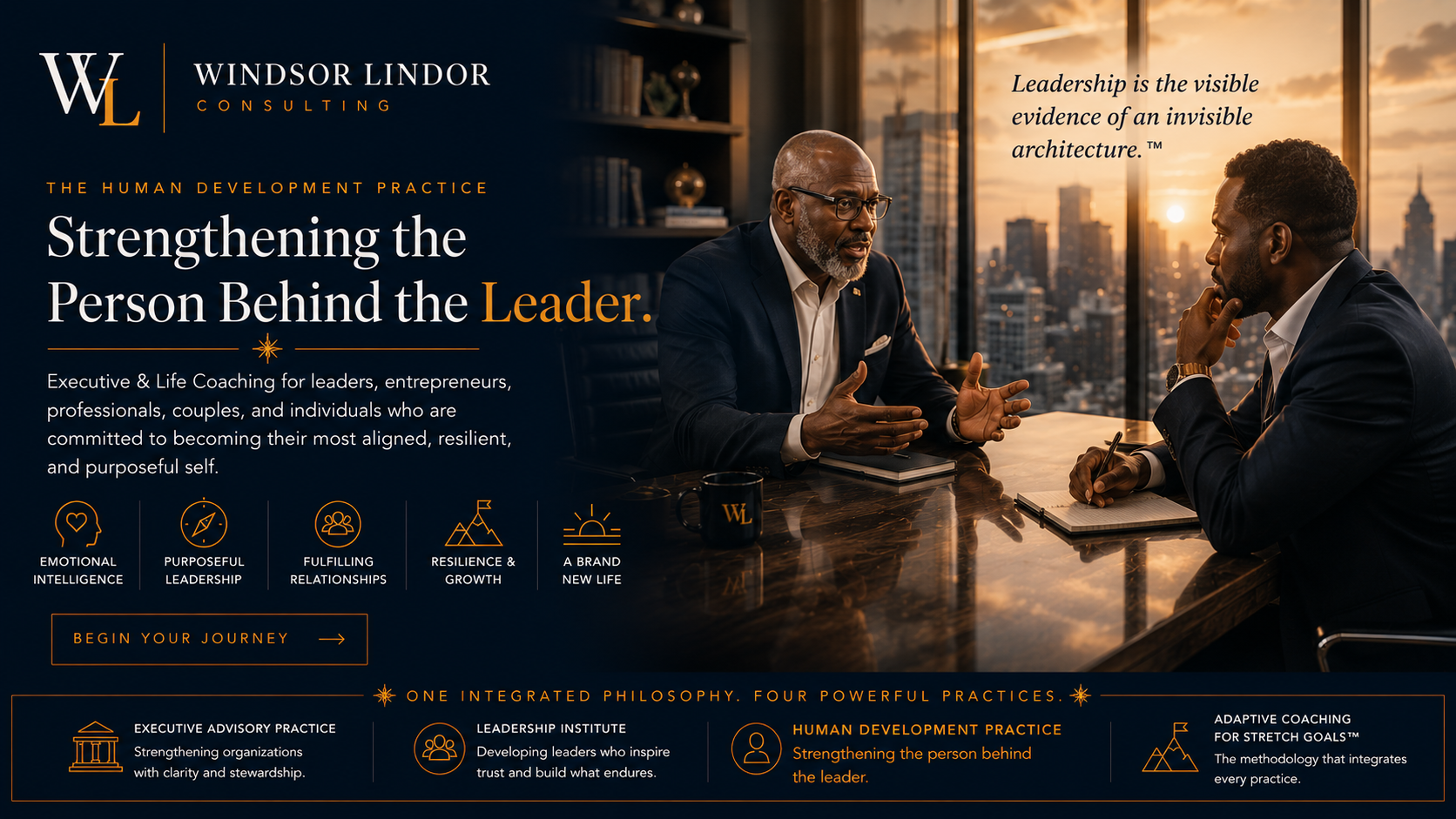
The Human Development Practice of Windsor Lindor Consulting
Culture of Success™ | Excellence in Action™
THE INNER ARCHITECTURE OF LEADERSHIP AND HUMAN DEVELOPMENT
Strengthen the Person. Elevate the Leader. Build What Endures.
The quality of our decisions, relationships, and leadership is profoundly influenced by the internal architecture from which we live and act.
Our beliefs shape perception. Our emotional patterns influence responses. Our values inform priorities. Our capacity for conscious choice determines how we exercise responsibility through life's complexities, transitions, and opportunities.
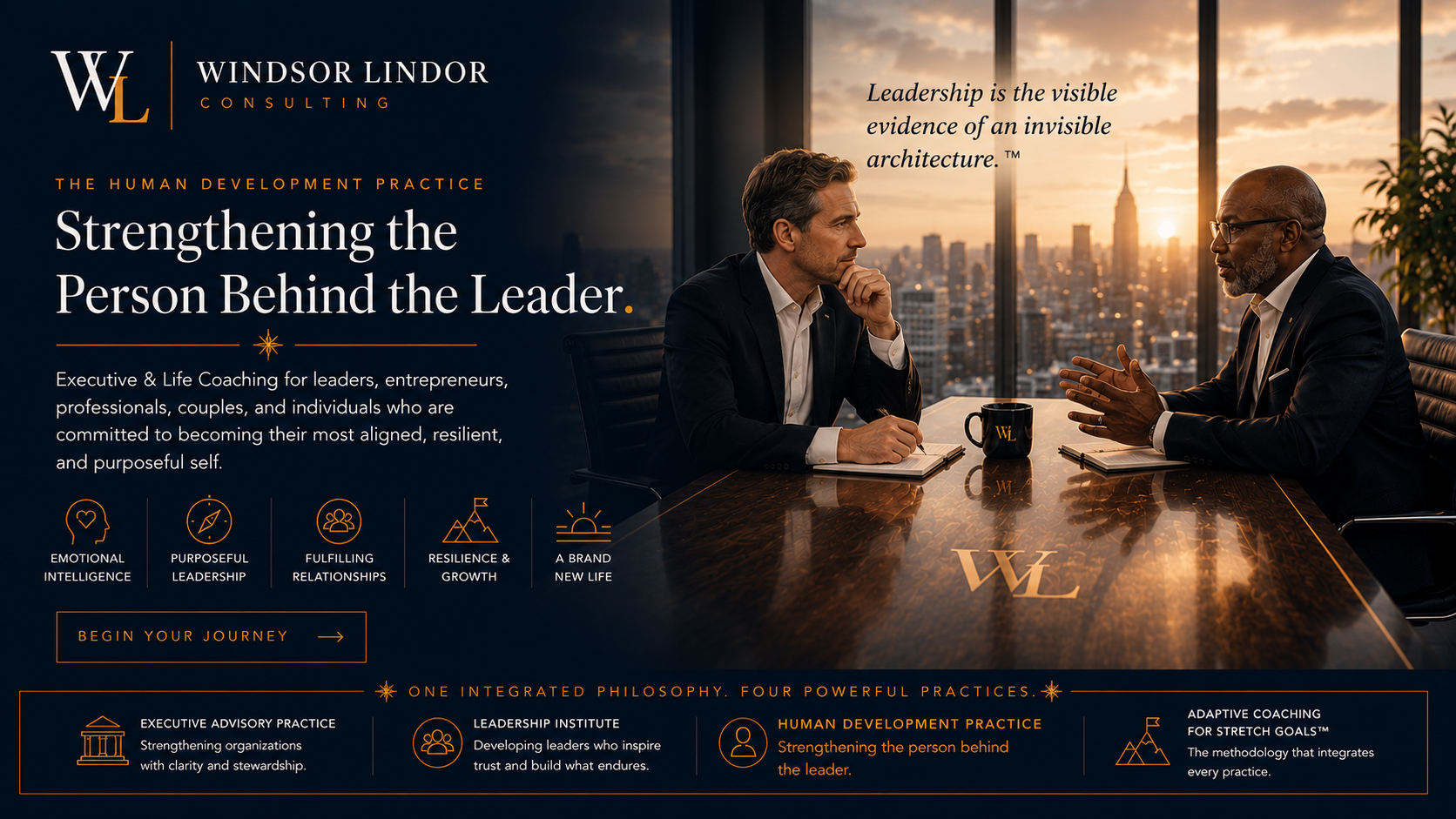
At Windsor Lindor Consulting, Executive & Life Coaching is a personalized, intellectually grounded partnership in human development, conscious self-leadership, and purposeful growth.
Through The Human Development Practice, we support executives, entrepreneurs, professionals, and individuals in developing greater self-awareness, emotional intelligence, relational maturity, responsible decision-making, and the internal capacity to pursue meaningful objectives.
Our purpose extends beyond helping you achieve a goal. We strengthen the human capacity required to lead, grow, and sustain meaningful progress.
OUR COACHING PHILOSOPHY
Leadership Begins Within. Excellence Becomes Visible Through Action.
Meaningful development requires more than identifying what we want to accomplish. It calls for examining who we are becoming, what influences our choices, and whether our present behaviors reflect the values and responsibilities we intend to honor.
Our philosophy is grounded in Culture of Success™, an integrated approach to human development, emotional intelligence, conscious leadership, accountability, and Excellence in Action™.
We recognize that:
Awareness creates the opportunity for conscious choice.
Emotional intelligence strengthens the quality of decisions and relationships.
Personal responsibility transforms reflection into intentional conduct.
Creative courage expands our capacity to adapt, reconsider, and grow.
Sustainable excellence develops through alignment between values, behavior, relationships, and responsibility.
The coaching relationship creates a thoughtful environment for examining these dimensions, understanding their influence, and applying new awareness to real decisions and experiences.
The quality of our outward leadership reflects the maturity of our inner development.
OUR INTEGRATED COACHING METHODOLOGY
Human Flourishing Is the Foundation of Every Great Leader.
Two Strategic Consultation Disciplines. One Coherent Developmental Approach.
Our methodology draws upon two distinct and mutually reinforcing disciplines.
The Human Development Practice
The Inner Architecture of Awareness, Conscious Choice, and Human Becoming
The Human Development Practice is the foundational discipline of our Executive & Life Coaching service.
It examines the relationship between identity, beliefs, emotional patterns, values, personal agency, and the choices through which individuals shape their lives.
The emphasis is on helping clients develop greater understanding of themselves, exercise conscious authorship, strengthen relationships, and translate internal awareness into intentional action.
Organizational Stewardship™
The Outer Architecture of Responsible Leadership and Sustainable Excellence
For executives, entrepreneurs, and organizational leaders, coaching may also incorporate dimensions of Organizational Stewardship™.
This discipline examines how leadership behavior influences strategic direction, organizational culture, accountability, decision-making authority, operating systems, and the conditions through which others perform and develop.
Its integration allows leadership coaching to consider both the development of the individual and the organizational responsibilities influenced by that individual's decisions.
Our distinction: Human Development focuses on the person and their internal developmental capacity. Organizational Stewardship examines the broader leadership responsibilities, relationships, and systems influenced by that person.
Not every client requires equal attention to both disciplines.
Our coaching framework adapts to the individual's circumstances, developmental priorities, and professional responsibilities.
DISCIPLINE ONE
THE HUMAN DEVELOPMENT PRACTICE
Five Dimensions of Inner Development
Human development begins with awareness of the internal structures that influence how we perceive, interpret, respond, and choose.
Our coaching conversations explore five interconnected dimensions.
01 | Self-Awareness and Inner Architecture
Understanding What Influences Your Choices
We examine personal beliefs, assumptions, experiences, emotional patterns, and established narratives that may be influencing how you approach important decisions.
Developmental Question
What belief, assumption, or recurring pattern may be influencing the way you understand your current circumstances?
Application: Recognizing recurring patterns, separating assumptions from evidence, and developing greater awareness of the internal influences shaping decisions.
02 | Emotional Intelligence and Relational Maturity
Strengthening the Capacity to Respond Consciously
Emotional intelligence strengthens our ability to recognize emotions, understand their influence, exercise empathy, establish healthy boundaries, and navigate complex relationships.
Developmental Question
How might greater emotional awareness influence the quality of your response in a challenging conversation or relationship?
Application: Strengthening emotional regulation, empathy, relational responsibility, effective communication, and the capacity to respond constructively under pressure.
03 | Conscious Authorship and Personal Responsibility
Moving from Established Patterns to Intentional Choice
Personal development becomes meaningful when awareness strengthens our capacity to exercise responsibility for present decisions and future direction.
Developmental Question
Where would taking greater responsibility for your next choice create a meaningful change in your life or leadership?
Application: Clarifying personal agency, developing values-informed decisions, strengthening accountability, and translating reflection into action.
04 | Creative Courage and Adaptive Growth
Expanding Beyond Familiar Limitations
Growth often requires reconsidering perspectives, habits, and assumptions that no longer support meaningful development.
Developmental Question
What possibility might become available if you reconsidered an assumption you have treated as permanent?
Application: Developing adaptive thinking, navigating uncertainty, examining alternatives, and strengthening confidence through informed practice.
05 | Inner Coherence and Values-Aligned Action
Building Consistency Between Values and Conduct
Inner coherence emerges when our intentions, priorities, decisions, and behaviors increasingly reflect what we consciously value.
Developmental Question
What would greater consistency between your values and daily choices look like at this stage of your life?
Application: Clarifying values, strengthening personal commitments, building intentional practices, and reviewing progress through observable behavior.
DISCIPLINE TWO
ORGANIZATIONAL STEWARDSHIP™
Five Dimensions of Responsible Leadership
For clients exercising organizational authority, leadership development includes examining the relationships, decisions, and systems through which responsibility becomes visible.
These five dimensions inform executive coaching when relevant to a client's leadership circumstances.
01 | Strategic Clarity and Purpose
Aligning Decisions with Meaningful Direction
Developing the ability to connect organizational purpose, priorities, and strategic choices.
Leadership Question
How clearly do your current decisions reflect the priorities and purpose you are responsible for advancing?
Application: Strategic thinking, priority alignment, decision clarity, and purposeful execution.
02 | Leadership Responsibility and Accountability
Exercising Authority with Integrity
Examining how leaders establish expectations, define responsibilities, exercise authority, and remain accountable for their decisions.
Leadership Question
Where would greater clarity about authority, responsibility, or accountability strengthen your effectiveness?
Application: Delegation, decision authority, professional boundaries, role clarity, and responsible leadership conduct.
03 | Human-Centered Systems Architecture
Creating Conditions That Support Effective Work
Understanding the relationship between people, workflows, communication structures, and organizational expectations.
Leadership Question
Which recurring organizational process or structural pattern is making effective performance more difficult than necessary?
Application: Systems awareness, operating rhythms, process clarity, coordination, and better-defined responsibilities.
04 | Culture, Trust, and Emotional Intelligence
Recognizing the Human Consequences of Leadership
Exploring how leadership behaviors influence trust, communication, organizational culture, and the quality of working relationships.
Leadership Question
What are your everyday leadership behaviors communicating about trust, accountability, and respect?
Application: Relational credibility, emotionally intelligent leadership, constructive communication, and organizational culture.
05 | Sustainable Performance and Organizational Continuity
Strengthening Capacity Beyond Immediate Results
Developing leadership practices that support organizational resilience, adaptive capacity, and sustainable effectiveness.
Leadership Question
What leadership capability or organizational condition needs strengthening today to support tomorrow's responsibilities?
Application: Leadership continuity, performance reflection, organizational resilience, and long-term stewardship.
HOW THE METHODOLOGY WORKS IN PRACTICE
Turning Developmental Insight into Meaningful Change
Our coaching conversations are not limited to abstract reflection.
We connect the developmental dimensions to situations, decisions, and responsibilities that clients are navigating in real life.
Example: Strengthening Personal Agency
A client may recognize that recurring self-doubt influences an important professional decision.
Through the Human Development Practice, the coaching conversation may explore the assumptions underlying that doubt, distinguish available evidence from personal interpretations, and identify an intentional next step.
The client then practices the selected behavior and returns with observations about the experience.
Progress is considered through the quality of the decision process, the client's willingness to act responsibly, and what the experience reveals about their developing capacity.
Example: Strengthening Executive Accountability
An organizational leader may be experiencing recurring difficulties with delegation, inconsistent follow-through, or unclear decision authority.
Through Organizational Stewardship™, the coaching conversation may examine the leader's assumptions about control, their communication of expectations, and the organizational structures influencing accountability.
The leader identifies an appropriate change, implements it within their authority, and reviews its effect on role clarity, communication, and follow-through.
Both examples illustrate the integration of reflective inquiry, intentional action, and evidence-informed developmental review.
The purpose is not simply to understand a challenge. It is to strengthen the capacity to respond to that challenge with greater awareness and responsibility.
Adaptive Coaching for Stretch Goals™
Develop the Capacity Required for What Comes Next
Meaningful aspirations frequently require us to strengthen capabilities beyond our established habits and present ways of operating.
Adaptive Coaching for Stretch Goals™ connects developmental insight with practical commitments, reflective exercises, and deliberate action..
The process considers two related questions:
What do you intend to accomplish?
Who must you continue becoming to pursue that objective with integrity, competence, and responsibility?
Depending on your circumstances, coaching may focus on emotional resilience, executive presence, personal confidence, strategic decision-making, relational maturity, adaptive thinking, or disciplined follow-through.
Progress is examined through the relationship between your actions, the capacities being developed, and the outcomes you are working toward.
A stretch goal becomes more meaningful when pursuing it also develops the person responsible for achieving it.
WHAT TO EXPECT FROM YOUR COACHING ENGAGEMENT
A Personalized Partnership in Development
Every coaching engagement is structured around your circumstances, responsibilities, and developmental priorities.
The work may include:
An initial developmental assessment conversation using selected dimensions of our coaching framework.
Clarification of personal, professional, and leadership priorities.
Reflective inquiry and structured journaling practices.
Emotional intelligence, communication, and relational.