
The Inner Architecture of Emotional Intelligence
The Quality of Your Inner World Shapes the Quality of Your Outer Influence.
The Quality of Your Inner World Shapes the Quality of Your Outer Influence.
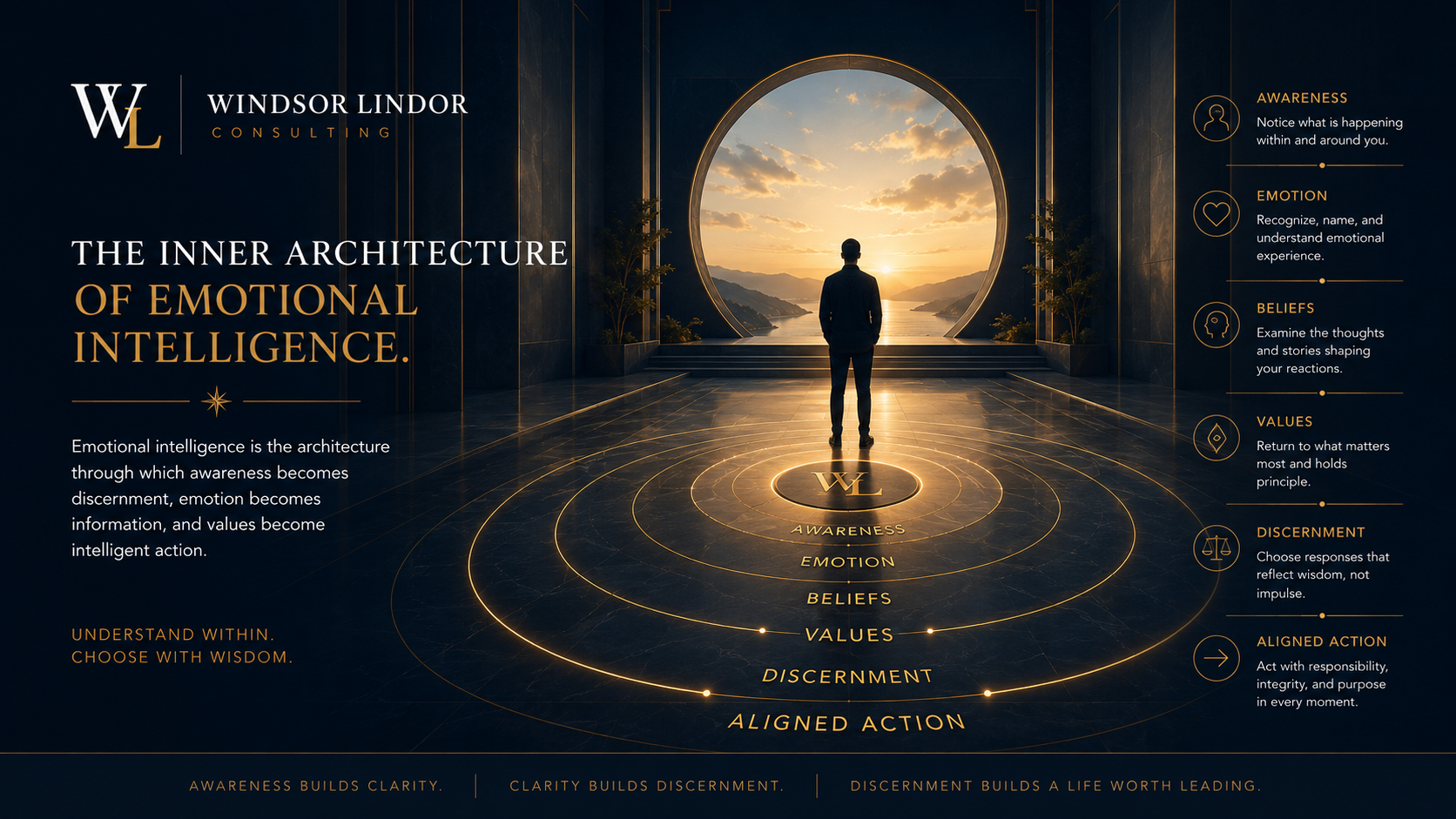
Emotional intelligence is the architecture through which awareness becomes discernment, emotion becomes information, and values become intelligent action.
We often experience emotional intelligence through visible outcomes.
A difficult conversation handled with maturity.
A leader who remains clear under pressure.
A person who recognizes fear without allowing fear to make the decision.
A relationship strengthened through honesty rather than defensiveness.
Yet these outward behaviors begin somewhere less visible.
They emerge from an inner architecture shaped by self-awareness, beliefs, values, emotional patterns, responsibility, identity, and the capacity to choose consciously.
This resource explores that architecture.
Because emotional intelligence is not simply the ability to manage feelings.
It is the capacity to understand what is happening within us deeply enough that our inner condition does not unconsciously govern our outer life.
THE CHALLENGE
Intelligence Alone Does Not Protect Us From Ourselves.
Highly capable people can still make emotionally costly decisions.
A leader may understand strategy and become defensive when challenged.
An entrepreneur may possess exceptional vision while allowing anxiety to create unnecessary urgency.
A professional may communicate with sophistication while avoiding the conversation that matters most.
A couple may genuinely love one another and still repeat patterns that weaken trust.
An individual may understand exactly what needs to change and continue behaving according to an older emotional script.
These are not necessarily failures of intelligence.
They are reminders that knowing and being able to respond wisely are different capacities.
Emotional patterns often operate faster than conscious reasoning.
Beliefs quietly influence interpretation.
Identity influences what feels threatening.
Fear can present itself as logic.
Pride can resemble certainty.
Avoidance can appear as patience.
Our internal world does not remain private.
It eventually enters our decisions, relationships, organizations, and leadership.
The deeper question is therefore not only:
What am I feeling?
It is:
What is this emotional experience preparing me to believe, decide, or do?
That is where emotional intelligence becomes consequential.
THE PHILOSOPHY
Emotional Intelligence Is an Inner Architecture.
Windsor Lindor Consulting approaches emotional intelligence as a developmental discipline rather than a collection of interpersonal techniques. The visible expression of emotional intelligence rests upon several internal structures.
Awareness allows us to notice.
Interpretation determines meaning.
Beliefs influence what we assume.
Values provide orientation.
Emotional regulation creates space.
Responsibility restores agency.
Discernment informs choice.
Action reveals what has actually been integrated.
This is why emotional intelligence belongs within Human Development.
It is not simply about appearing calm.
It is not about suppressing anger.
It is not about avoiding conflict.
It is not about becoming endlessly agreeable.
And it is not about eliminating difficult emotions.
Emotions are part of human intelligence. They carry information.
Fear may reveal uncertainty.
Anger may reveal a violated value or expectation.
Sadness may reveal loss.
Anxiety may expose the gap between what we can control and what we are attempting to control.
The developmental task is to learn how to receive emotional information without surrendering judgment to it.
That distinction changes everything.
01 | Self-Awareness
Emotional intelligence begins with accurate observation.
Self-awareness asks us to notice:
What am I feeling?
What triggered the response?
What story am I attaching to what happened?
What physical signals am I experiencing?
What familiar pattern may be present?
What might I be overlooking because of my emotional state?
Awareness does not require immediate correction.
It requires honesty.
We cannot intelligently govern what we are unwilling to see.
CAPABILITY
The Six Dimensions of Emotional Intelligence From the Inside Out
02 | Emotional Literacy
Naming an emotion increases our capacity to understand it.
“Upset” can conceal anger, disappointment, embarrassment, fear, resentment, grief, or uncertainty.
Those emotions are not interchangeable.
Each carries different information.
Emotional literacy allows us to move from a vague internal state toward greater precision.
The question becomes:
What am I actually experiencing?
Precision creates choice.
03 | Beliefs & Interpretation
Emotions do not arise from circumstances alone.
They are influenced by how we interpret circumstances. Two people can encounter the same event and experience very different emotional responses because they assign different meanings to what happened. This is where belief systems become important.
An unanswered email can become:
“They do not respect me.”
“They must be busy.”
“I said something wrong.”
“I need more information.”
The external event remains unchanged. The internal interpretation changes everything that follows.
Emotional intelligence therefore requires the willingness to examine the assumptions beneath the emotion.
04 | Values & Inner Alignment
Emotions can tell us what matters. Values help us decide what deserves authority.
When pressure rises, emotional intelligence invites a return to principle.
What value should guide my response?
Respect?
Integrity?
Courage?
Compassion?
Accountability?
Truth?
Boundaries?
Values create an internal reference point when circumstances become emotionally charged.
They allow us to move from reaction toward alignment.
05 | Regulation & Discernment
Regulation is not emotional suppression.
It is the ability to remain sufficiently present that emotion does not automatically become behavior.
This may involve:
Pausing
Breathing
Creating distance
Asking a better question
Seeking additional information
Delaying a consequential response
Listening before defending
Distinguishing urgency from importance
Regulation creates the space in which discernment becomes possible.
And discernment asks:
What response best reflects reality, values, responsibility, and the outcome worth protecting?
06 | Responsibility & Aligned Action
Emotional intelligence becomes meaningful when awareness changes participation.
Insight alone is incomplete.
We may understand why we became defensive and remain defensive.
We may recognize an unhealthy pattern and continue reproducing it.
We may identify the value at stake and still avoid acting from it.
Responsibility asks:
What is this awareness now asking me to do differently?
Aligned action may be:
A conversation.
A boundary.
An apology.
A request for clarification.
A changed decision.
A different leadership response.
A commitment to stop repeating a pattern.
This is where emotional intelligence becomes Excellence in Action.
THE INNER ARCHITECTURE
The Emotion Is Real. The First Interpretation May Not Be.
One of the most important disciplines of emotional intelligence is learning to separate:
Experience from interpretation.
Consider a leader who receives unexpected resistance during a meeting.
The emotional experience may be real:
Frustration.
Embarrassment.
Concern.
Fear of losing authority.
The interpretation may be:
“They are undermining me.”
That interpretation may be true. It may also be incomplete.
Perhaps the team has information the leader does not have.
Perhaps expectations were unclear.
Perhaps the proposed direction creates consequences leadership has not yet seen.
Perhaps resistance reflects fear rather than disloyalty.
Emotional intelligence does not tell the leader to ignore the feeling.
It asks the leader not to confuse the feeling with the final truth.
This is a mature distinction.
Emotion deserves attention. Interpretation deserves examination.
EMOTION → INTERPRETATION → AWARENESS → VALUES → DISCERNMENT → ACTION
IDEAS IN ACTION
A Practical Emotional Intelligence Pause
When an emotional response begins influencing a consequential decision, conversation, or relationship, use this five-question pause.
NOTICE
What am I feeling?
Name the emotional experience as precisely as possible.
SEPARATE
What happened, and what am I interpreting?
Distinguish observable reality from the story being created around it.
EXAMINE
What belief, fear, expectation, or previous experience may be influencing this response?
Look beneath the emotion without condemning yourself for having it.
ALIGN
What value deserves authority here?
Return to the principle you want your behavior to reflect.
CHOOSE
What response would represent greater emotional maturity?
Move from awareness into responsible action.
The purpose is not to create a perfect response.
It is to interrupt unconscious repetition.
WHY THIS MATTERS IN LEADERSHIP
Emotional Patterns Do Not Remain Private When We Carry Responsibility.

The greater a person's influence, the greater the consequences of unmanaged emotional patterns.
A leader's anxiety can become organizational urgency.
A leader's avoidance can become cultural silence.
A leader's defensiveness can suppress information.
A leader's lack of boundaries can become organizational exhaustion.
A leader's emotional steadiness can create psychological room for others to think.
This is why emotional intelligence belongs inside leadership development.
Leadership is relational.
Decisions are relational.
Culture is relational.
Trust is relational.
The leader's inner condition enters every one of those systems.
This does not mean leaders must become emotionally flawless.
It means they carry a responsibility to understand how their internal condition affects other people.
That responsibility is part of mature leadership.
WHY THIS MATTERS IN RELATIONSHIPS
Emotional Intelligence Is Also Relational Intelligence.
Human relationships are shaped not simply by what we intend to communicate, but by what another person experiences through our behavior.
A person may intend honesty and communicate aggression.
Another may intend peace and repeatedly communicate avoidance.
Someone may intend care while expressing control.
Emotional intelligence helps us examine the space between intention and impact.
That space is central to healthy relationships.
It allows us to ask:
What am I protecting?
What am I afraid to say?
What am I assuming about the other person?
What does this relationship require from me that my defensiveness is preventing?
What boundary would protect dignity rather than punish?
The aim is not constant agreement.
It is greater relational consciousness.
BODY OF WORK
Emotional Intelligence Within the Windsor Lindor Consulting Developmental Architecture
The Inner Architecture of Emotional Intelligence belongs to a larger body of thinking developed across Windsor Lindor Consulting.
Adaptive Coaching for Stretch Goals™
How people grow.
Strengthening the emotional, behavioral, and strategic capacity required to pursue meaningful goals.
Culture of Success™
How leaders live and organizations perform.
Integrating values, emotional intelligence, responsibility, relationships, purpose, and Excellence in Action.
Transformational Leadership
How leaders develop from the inside out.
Applying self-awareness, emotional intelligence, inner authority, values, and responsibility to consequential leadership.
Systems-Aligned Leadership™
How leadership and organizational systems become coherent.
Recognizing that the emotional condition of leaders affects culture, decision-making, accountability, and execution.
Organizational Stewardship™
How organizations endure.
Extending leadership beyond immediate performance toward institutional integrity, governance, resilience, and long-term responsibility.
These frameworks address different dimensions of one larger philosophy:
Awareness Deepens.
Responsibility Expands.
Leadership Matures.
Relationships Strengthen.
Systems Align.00000
Organizations Endure.
SELF-ASSESSMENT
How Emotionally Intelligent Is Your Current Way of Responding?
Use these questions for individual reflection or leadership development.
Awareness
Can I identify my emotional state before acting from it?
Do I recognize recurring triggers?
Can I distinguish facts from assumptions?
Values
Do my responses reflect what I claim to value?
Do my boundaries protect integrity rather than simply reduce discomfort?
Can I remain aligned when approval is uncertain?
Regulation
Can I remain present when uncomfortable emotions arise?
Do I create space before consequential reactions?
Can I communicate difficult truths without unnecessary aggression?
Relationships
Do I consider the impact of my behavior as well as my intention?
Can I listen without immediately preparing a defense?
Am I willing to repair when my behavior has caused harm?
Responsibility
Can I recognize what belongs to me without assuming responsibility for everything?
Do I convert awareness into changed behavior?
Am I willing to examine patterns that repeatedly create the same consequence?
Hesitation does not indicate failure.
It identifies an opportunity for deeper development.
This work naturally opens larger questions:
How do beliefs shape emotional reactions?
What is the difference between emotional regulation and emotional suppression?
How does emotional intelligence affect executive decision-making?
What happens when professional competence develops faster than emotional maturity?
How do leaders distinguish intuition from fear?
How does identity influence defensiveness?
What role do values play during emotional conflict?
Can emotional intelligence strengthen organizational culture?
These questions relate to the continuing work of Human Development.
CONTINUED EXPLORATION
Emotional Intelligence Is a Lifelong Practice.
Continue Exploring
Transformational Leadership
Explore how emotional intelligence becomes leadership capacity.
Executive & Life Coaching
Explore the Human Development Practice.
Leadership Resources
Continue exploring emotional intelligence, self-leadership, resilience, relationships, and organizational effectiveness.
CONSULTATION
When Awareness Reveals Work Worth Doing.
A resource can help us see more clearly.
Sometimes greater clarity reveals a pattern, transition, relationship, leadership responsibility, or emotional habit that deserves deeper work.
You may be navigating increasing leadership responsibility.
A recurring emotional pattern may be affecting judgment or relationships.
You may understand what needs to change and find that understanding alone has not changed the behavior.
Or perhaps nothing is fundamentally wrong.
You may simply recognize that becoming more emotionally intelligent is part of becoming a more responsible, coherent, and fully developed human being.
Windsor Lindor Consulting works with executives, entrepreneurs, professionals, couples, and individuals through Human Development, Executive & Life Coaching, Adaptive Coaching for Stretch Goals™, and leadership development.
The purpose is not to remove emotion from your life.
It is to strengthen your capacity to understand emotion, live from your values, relate more consciously, and choose with greater wisdom.
Build What Endures.