
THE INNER ARCHITECTURE OF THE SUCCESSFUL ENTREPRENEUR
The Laws That Sustain Business, Leadership, and Growth
Many entrepreneurs are doing the visible things correctly.
They invest in strategy.
They refine their branding.
They improve their offers.
They strengthen systems.
They market consistently.
They work diligently to execute their vision.
From the outside, the business may appear positioned for success.
Yet sustained results are rarely built on visible effort alone. They are shaped by the deeper architecture operating underneath the business itself. A business eventually mirrors the internal condition of the person leading it.
The entrepreneur’s mindset, emotional intelligence, belief system, discipline, resilience, self-trust, and leadership maturity become embedded in decision-making, culture, communication, relationships, and execution.
Over time, the internal world of the leader becomes the operational rhythm of the organization.
Why Strategy Alone Is Not Enough
Strategy matters.
A business needs direction, positioning, financial clarity, operational systems, market intelligence, and disciplined execution. Yet strategy performs best when the entrepreneur has developed the inner stability and leadership capacity required to sustain pressure, uncertainty, growth, and responsibility without losing alignment.
Many businesses do not struggle because of a lack of intelligence.
They weaken because the internal foundation beneath the vision has not been strengthened enough to carry the weight of expansion. This is where business consulting, executive coaching, leadership development, and strategic advisory work must meet at a deeper level.
The entrepreneur does not only need a plan. They need the inner architecture to carry the plan. The Inner Foundation Behind Outer Impact
Entrepreneurship is not only about building a company.
It is also about building the internal structure capable of sustaining growth with clarity, wisdom, emotional maturity, and integrity.
The quality of how an entrepreneur stands, feels, thinks, communicates, decides, and carries responsibility influences the quality of the culture they create, the opportunities they attract, and the decisions they are willing to make under pressure.
This is leadership at the level of identity.
It includes clarity of purpose, emotional intelligence, disciplined thinking, self-governance, aligned decision-making, creative courage, operational focus, financial stewardship, and the ability to remain coherent while the vision expands.
When inner alignment strengthens, execution becomes more coherent.
Leadership becomes more trustworthy.
Creativity becomes more focused.
Decision-making becomes less reactive.
Culture becomes more intentional.
This is where entrepreneurs move from survival-based leadership into values-aligned leadership.
The Core Laws That Govern Sustained Entrepreneurial Success
Sustained Entrepreneurial Success
The inner architecture of the entrepreneur becomes the leadership architecture of the business.
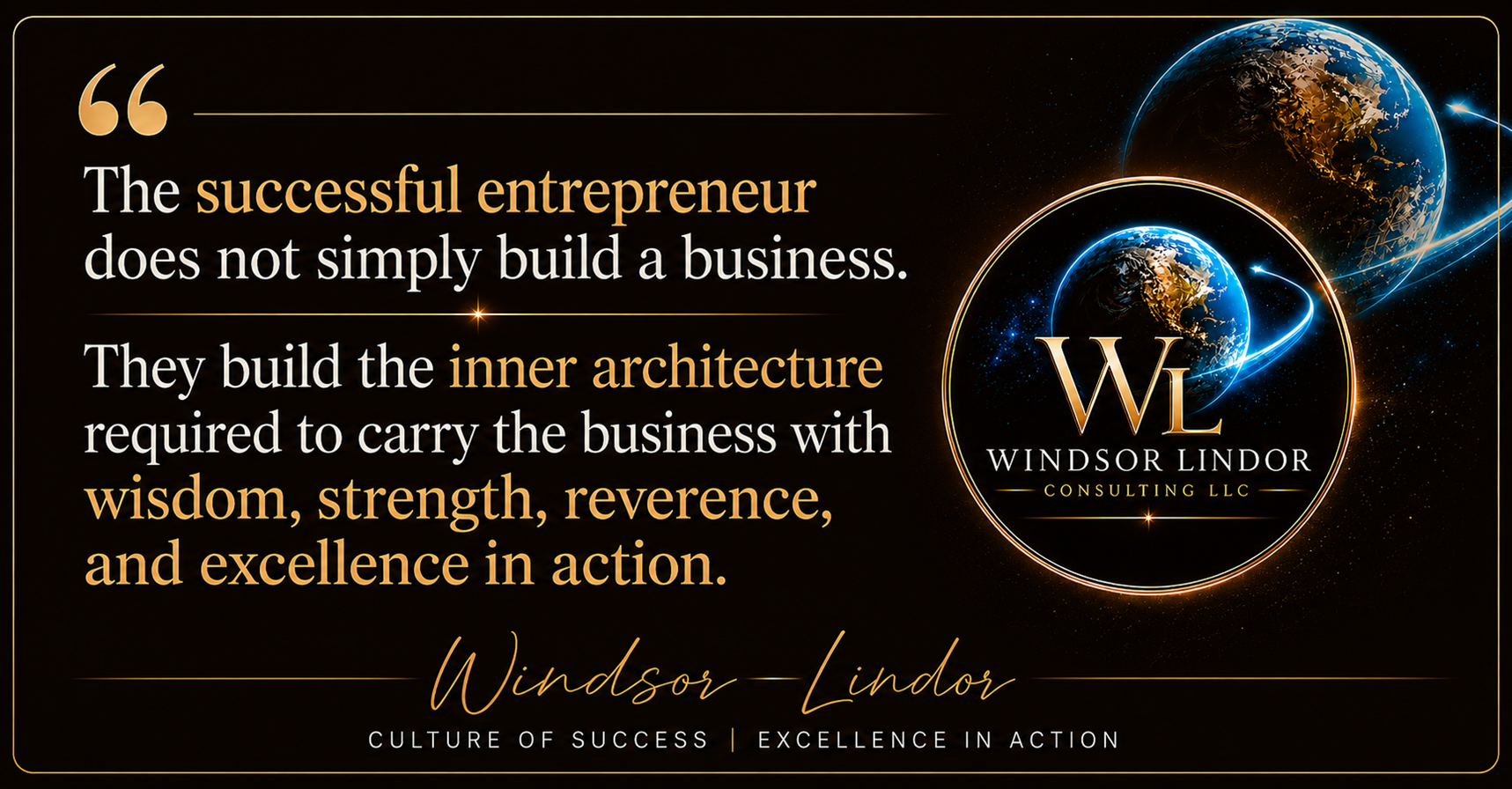
The successful entrepreneur does not simply build a business.
They build the inner architecture required to carry the business with wisdom, strength, reverence, and excellence in action. The following laws offer a deeper leadership framework for entrepreneurs who want to build success that is not only visible, also sustainable, meaningful, and aligned.
1. The Law of Inner Architecture
This law begins with the structure beneath performance. An entrepreneur’s outer results rarely rise above their inner structure. Clarity, discipline, emotional intelligence, self-trust, and alignment become the invisible architecture behind visible success.
This law asks a deeper question: What internal structure is carrying the business?
If the entrepreneur’s inner world is reactive, unclear, scattered, or misaligned, those patterns eventually appear in the organization.
If the entrepreneur’s inner world is grounded, clear, emotionally governed, and values-aligned, the business gains a stronger foundation for sustainable growth.
The inner architecture of the entrepreneur becomes the leadership architecture of the business.
2. The Law of Belief
This law reveals the mindset behind the model. Every business is first built inside the entrepreneur’s belief system. A limited mindset produces hesitation, inconsistency, and underdeveloped vision. An empowered belief system creates courage, resilience, and decisive action.
Belief is not wishful thinking. It is the internal permission structure that determines what the entrepreneur is willing to attempt, sustain, refine, and become responsible for.
A meaningful life is created, not wished for. The entrepreneur who strengthens belief also strengthens capacity. They begin to embody, build, and create a life and business culture that is sustainable, meaningful, and truly their own.
3. The Law of Alignment
This law protects success from becoming internally costly. Success becomes sustainable when the entrepreneur’s vision, values, behavior, and business model are aligned.
Misalignment may still produce activity. It also produces exhaustion, confusion, and results that do not feel deeply fulfilling.
Alignment creates coherence. It allows the entrepreneur to lead from purpose rather than pressure. It ensures that the business does not expand in a way that violates the values of the person leading it.
4. The Law of Emotional Governance
This law governs the leader beneath the pressure. A successful entrepreneur must know how to lead their own nervous system. Emotional intelligence allows the leader to respond instead of react, listen instead of defend, and decide from clarity instead of fear.
This is not soft work. It is executive-level governance. When a leader cannot regulate emotion, the business often absorbs the instability. Communication becomes strained. Decisions become reactive. Culture becomes uncertain.
When a leader develops emotional governance, the business gains steadiness.
Trust strengthens.
Clarity improves.
Relationships mature.
Execution becomes cleaner.
5. The Law of Discipline
This law transforms vision into reliable structure. Vision without discipline becomes inspiration without architecture.
Discipline turns ideas into systems.
Systems create consistency.
Consistency builds trust.
The entrepreneur who honors discipline learns to translate purpose into repeatable action. This is where the vision becomes operational through structure, rhythm, accountability, and intentional practice.
6. The Law of Creative Courage
This law activates the entrepreneur’s willingness to build before certainty arrives. Entrepreneurship requires the courage to create while the full path is still unfolding.
The successful entrepreneur learns to move with intelligence, adapt with grace, and innovate without waiting for perfect conditions. That is creative courage. The willingness to act while still refining, and it is also:
The discipline of building while learning. It is the maturity to honor imagination and execution at the same time.
This law separates those who only think about possibility from those who give form to it.
7. The Law of Resonance
This law recognizes that the entrepreneur’s presence becomes part of the brand. Who the entrepreneur is becoming affects what the business attracts.
Presence matters.
Language matters.
Standards matter.
Energy matters.
Integrity matters.
The entrepreneur’s resonance influences the quality of clients, partnerships, opportunities, and culture. This does not replace strategy. It deepens strategy. The market responds not only to what a business offers. It also responds to the trust, clarity, and coherence the business communicates.
8. The Law of Service
This law keeps the business connected to real value. A business grows when it solves real problems with genuine value. The entrepreneur must remain connected to the people they serve, not only the product they sell.
Service keeps ambition grounded. It reminds the entrepreneur that sustainable success is built through usefulness, care, excellence, relevance, and the ability to create meaningful outcomes for others.
9. The Law of Strategic Clarity
This law protects the entrepreneur from scattered execution.
Confusion is expensive. Successful entrepreneurs clarify their offer, audience, message, priorities, systems, standards, and next steps.
Clarity protects time.
Clarity protects energy.
Clarity protects money.
Clarity protects momentum.
Strategic clarity allows the entrepreneur to stop scattering their power across too many directions. It creates a clean line between purpose, priorities, and execution.
For leaders seeking structured support in this work, explore Strategic Consulting for Boards and CEOs:
10. The Law of Adaptability
This law allows the entrepreneur to evolve without losing their core identity.
The market will change.
People will change.
Conditions will change.
Opportunities will change.
Expectations will change.
The successful entrepreneur does not collapse under change. They learn, recalibrate, and evolve without abandoning their core identity.
Adaptability is not instability. It is the ability to remain rooted while responding intelligently to reality.
11. The Law of Self-Leadership
This law is the foundation of every leadership expression. Before an entrepreneur can lead a company, team, brand, or movement, they must lead themselves. Self-leadership is the daily practice of governing attention, decisions, habits, emotions, and commitments.
It is where leadership becomes personal before it becomes organizational.
The entrepreneur who cannot lead themselves will eventually struggle to lead the business with steadiness.
The entrepreneur who can lead themselves creates a foundation for trust, culture, and sustainable execution.
12. The Law of Sustained Success
This law gathers the full architecture into one leadership truth.
Sustained success is not built by strategy alone. It is built by the inner architecture of the entrepreneur.
Clarity.
Discipline.
Emotional intelligence.
Creative courage.
Self-awareness.
Strategic thinking.
Aligned action.
The ability to remain coherent while the vision expands. This law reminds us that outer impact is sustained by inner order. Stillness becomes the sacred space where illusions dissolve and truth begins to surface.
Legacy is born from authenticity. Impact endures when leadership is rooted in character, service, emotional maturity, and disciplined excellence.
Building a Culture of Success
As a change expert and business consultant, I have learned that authentic power is not built through performance alone. It emerges when entrepreneurs develop the capacity to think clearly, regulate emotionally, lead intentionally, and remain connected to the deeper purpose behind their work.
This is where emotional wellness, creative intelligence, strategic thinking, and disciplined leadership begin to work together as one coherent force. When inner alignment strengthens, execution becomes more coherent.
Leadership becomes more trustworthy.
Creativity becomes more focused.
Decision-making becomes more intentional.
Culture becomes more resilient.
This deeper work is where entrepreneurs move beyond temporary momentum and begin building a true Culture of Success.
One is rooted in self-awareness, disciplined action, emotional maturity, strategic clarity, and excellence in action.
A Leadership Question Worth Holding
What part of your business may be asking for a stronger strategy? And what part may be asking for a stronger inner architecture?
That distinction matters. Because the next level of growth may not only require a better plan. It may require a more aligned, emotionally intelligent, strategically clear, and self-led version of the entrepreneur carrying the plan.
Next Step
If you are a CEO, founder, board member, or executive leader seeking governance that holds, strategy that moves, and culture that lasts, explore Strategic Consulting for Boards and CEOs:
Share this blog with a colleague, leadership team, or board that is ready to think more deeply about the inner and operational laws that sustain success.
Windsor Lindor
Culture of Success | Excellence in Action