Steward the Organization You Are Responsible for Leading.
Where governance, leadership, strategy, culture, and long-term responsibility become one discipline.
Boards and CEOs carry a particular kind of responsibility.
Their decisions influence more than immediate performance. They shape organizational priorities, allocate resources, establish accountability, influence culture, manage risk, protect mission, and affect an organization's capacity to remain viable through changing conditions.
That responsibility requires more than effective management.
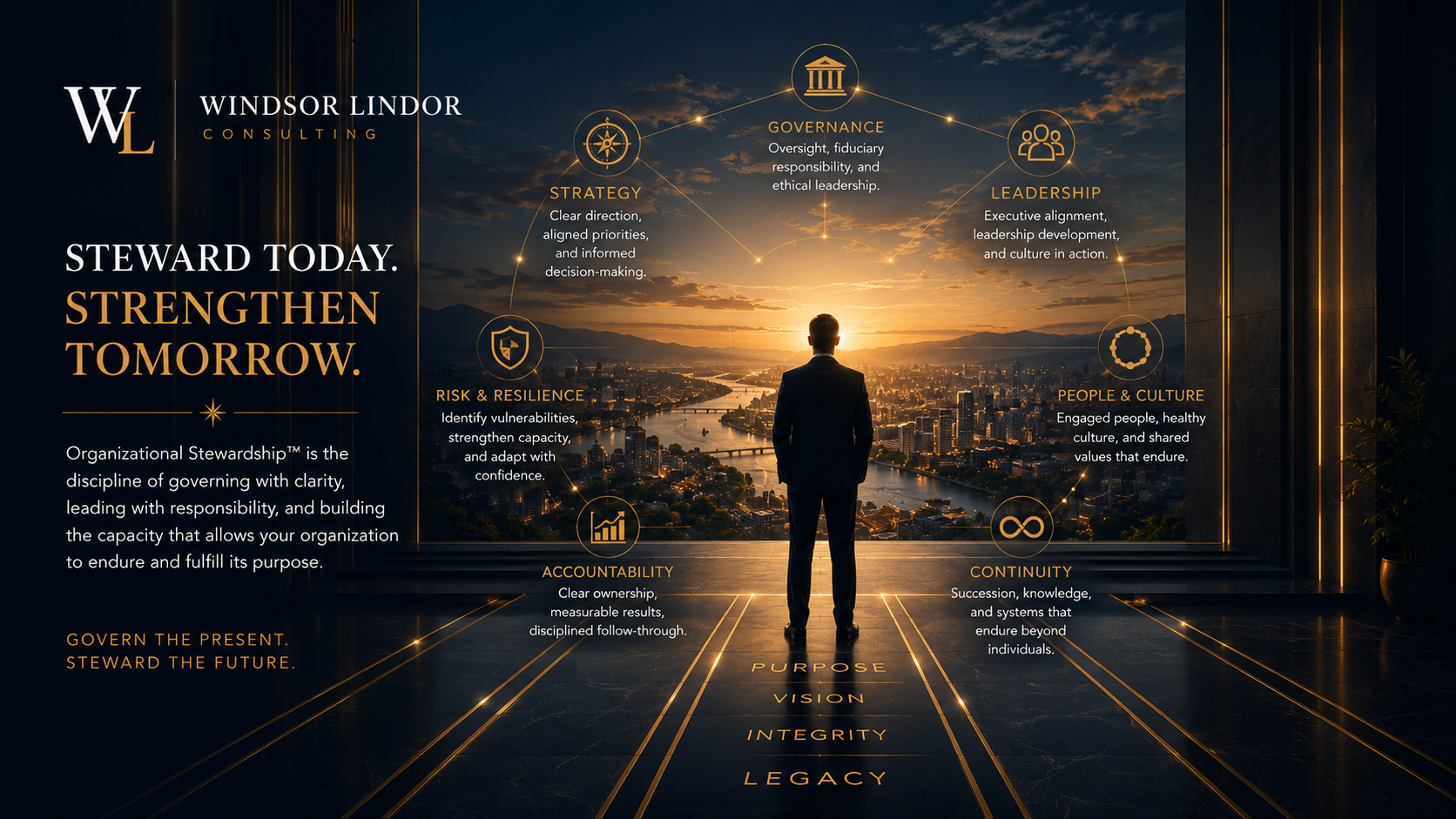
It requires Organizational Stewardship™.
At Windsor Lindor Consulting, stewardship describes the disciplined responsibility to lead the organization entrusted to us in ways that strengthen its capacity to fulfill its purpose today without compromising its ability to endure tomorrow.
This resource examines the architecture of that responsibility and how boards and CEOs can strengthen governance, strategic clarity, leadership alignment, organizational resilience, and disciplined execution.
Govern the Present. Steward the Future.
CHALLENGE
Complexity at the Top Rarely Stays at the Top.
Organizations often experience symptoms before leadership recognizes the underlying architecture producing them.
A strategy exists, yet execution remains inconsistent.
Board members and executives understand their responsibilities individually, yet decision rights remain unclear collectively.
Growth increases activity faster than organizational capacity.
Meetings multiply while accountability becomes less certain.
Values are articulated, yet culture communicates something different.
The organization responds successfully to today's pressure while quietly increasing tomorrow's vulnerability.
These conditions are often described as strategic, operational, governance, or cultural problems.
They may be all four.
At the Board and CEO level, organizational challenges rarely exist independently. Governance affects authority. Authority affects decisions. Decisions affect execution. Leadership behavior influences culture. Culture affects information, accountability, trust, and ultimately performance.
The current page correctly observes that small misalignments at the highest levels can produce disproportionate consequences.
The deeper principle is:
What remains misaligned at the top eventually becomes expensive somewhere else in the system.
The task of stewardship is therefore not simply to solve the visible problem.
It is to understand what organizational condition allowed that problem to persist.
PHILOSOPHY
From Leadership to Organizational Stewardship™
Leadership and stewardship overlap, yet they are not identical.
Leadership concerns influence, direction, judgment, relationships, decisions, and the mobilization of people toward meaningful outcomes.
Stewardship introduces another dimension:
What are we responsible for preserving, strengthening, developing, and eventually transferring to those who come after us?
A CEO may occupy a position for years.
A board member serves for a term.
The organization must be capable of continuing beyond either.
This changes the executive question from:
How do we achieve the next objective?
to:
What must we strengthen now so this organization remains capable of fulfilling its purpose across changing seasons?
That shift expands leadership responsibility.
Strategy becomes more than planning.
Governance becomes more than compliance.
Culture becomes more than employee sentiment.
Resilience becomes more than emergency response.
Succession becomes more than replacing individuals.
Performance becomes more than achieving a number.
Each becomes part of the organization's capacity to endure.
Organizational Stewardship™ therefore asks leaders to hold two horizons simultaneously:
The responsibility of now, and the consequences of what now creates next.
That is leadership with a longer field of vision.
CAPABILITY
The Architecture of Organizational Stewardship™
01 | PURPOSE & MISSION
What must remain worth protecting?
Organizations require clarity about why they exist, whom they serve, what they are responsible for accomplishing, and which principles should remain intact as circumstances change.
Purpose provides continuity when strategy must evolve.
02 | GOVERNANCE & AUTHORITY
Who is responsible for what?
Effective governance establishes appropriate boundaries among oversight, leadership, management, and execution.
Boards must govern without unnecessarily managing.
CEOs must lead with sufficient authority while remaining appropriately accountable.
Ambiguous authority creates hesitation, duplication, interference, and organizational risk.
03 | STRATEGY & DECISION RIGHTS
How will intention become coordinated choice?
Strategy requires more than priorities.
Organizations need clear decision pathways, appropriate ownership, escalation mechanisms, and disciplined choices about resources and tradeoffs.
Decision architecture determines whether strategic intent can travel through the organization.
04 | CULTURE & ACCOUNTABILITY
What behavior does the system actually reinforce?
Culture is created through repeated experience.
What leaders tolerate, reward, question, model, communicate, and hold accountable gradually teaches people how the organization actually operates.
Values become credible when systems reinforce them.
05 | RESILIENCE & ADAPTIVE CAPACITY
What happens when conditions change?
Healthy organizations need sufficient financial, leadership, operational, relational, and strategic capacity to absorb disruption without abandoning sound judgment.
Resilience is not simply recovering from difficulty.
It is developing sufficient capacity to adapt without losing organizational coherence.
06 | CONTINUITY & STEWARDSHIP
What are we preparing to leave stronger?
The ultimate test of stewardship is not whether an organization succeeds while a particular leader is present.
It is whether leadership has strengthened the organization sufficiently that purpose, knowledge, governance, culture, systems, and capacity can continue beyond individual tenure.
That is where leadership begins to become legacy.
One of the most consequential relationships in any organization is the relationship between its governing body and chief executive.
Healthy governance does not require the board and CEO to perform the same work.
It requires them to understand how their different responsibilities contribute to the same organizational purpose.
THE GOVERNANCE RELATIONSHIP
Board and CEO: Distinct Responsibilities. Shared Stewardship.
THE BOARD
The board governs.
Its responsibilities include oversight, fiduciary stewardship, executive accountability, strategic direction at the appropriate level, organizational sustainability, and protection of mission.
THE CEO
The CEO leads the enterprise.
The chief executive translates strategic direction into organizational priorities, builds leadership capacity, allocates resources, develops culture, manages execution, and ensures the organization can fulfill its responsibilities.
THE SHARED SPACE
Some matters require disciplined collaboration:
Strategic direction.
Enterprise risk.
CEO performance.
Organizational health.
Major transitions.
Financial sustainability.
Succession.
Mission integrity.
The objective is not blurred responsibility.
It is coherent responsibility.
Good governance creates enough distinction for accountability and enough alignment for the organization to move.
SYSTEMS-ALIGNED STEWARDSHIP
The Organization Must Be Designed to Carry Leadership Intent.
A board can approve a sound strategy. A CEO can communicate it clearly.
Neither guarantees execution.
Between intention and outcome sits an organizational system.
Purpose → Governance → Leadership → Strategy → Decisions → People → Culture → Execution → Learning → Renewal
Weakness anywhere in this architecture can distort what leadership intends.
For example:
A strategic priority without ownership becomes aspiration.
Accountability without decision authority creates frustration.
Values without reinforcement become language.
Growth without capacity creates fragility.
Governance without boundaries creates interference.
Leadership without feedback creates blind spots.
This is why Strategic Consulting for Boards & CEOs should be grounded in systems thinking rather than isolated interventions.
The question is not merely:
What should leadership do?
It is also:
What must the organization make possible for responsible leadership to work?
IDEAS IN ACTION
The Stewardship Lens™
Because governance isn’t paperwork—it’s how responsibility becomes operational.
Before making a consequential Board or CEO decision, I recommend using five questions.
PURPOSE
What organizational purpose or responsibility are we protecting?
Begin beyond preference and personality.
REALITY
What is actually true about the present condition?
Separate evidence from assumption, history, politics, and aspiration.
RESPONSIBILITY
Who appropriately owns this decision and its consequences?
Clarify governance, authority, accountability, and implementation.
CONSEQUENCE
What could this decision create beyond the immediate result?
Examine cultural, financial, human, operational, strategic, and reputational consequences.
ENDURANCE
Will this decision strengthen or weaken the organization's future capacity?
Look beyond resolution toward stewardship.
BOARD & CEO SELF-ASSESSMENT
Questions Responsible Leadership Should Be Willing to Ask.
This gives the resource practical executive value without becoming a consulting pitch.
Governance
Are Board and CEO responsibilities sufficiently clear?
Does the board govern at the appropriate altitude?
Are consequential decisions made at the correct level?
Strategy
Can leadership articulate the organization's few highest priorities?
Are resources aligned with those priorities?
Can strategy survive contact with operating reality?
Accountability
Is ownership clear when something important must happen?
Do people have sufficient authority to carry their responsibilities?
Does leadership address persistent nonperformance?
Culture
Does lived behavior reinforce stated values?
Can difficult information move upward safely?
What behavior is leadership unintentionally teaching people to accept?
Resilience
Where is the organization currently dependent upon one person, relationship, revenue source, system, or assumption?
What disruption would expose the greatest vulnerability?
What capacity should be strengthened before it becomes urgent?
Continuity
Is leadership developing future leadership?
Is institutional knowledge protected?
Would important systems continue functioning through an unexpected leadership transition?
Hesitation around these questions is useful information.
It identifies where stewardship may require greater attention.
BODY OF WORK
Organizational Stewardship™ Within the Windsor Lindor Consulting Architecture
Organizational Stewardship™ does not stand alone.
It represents the long-term organizational expression of a larger body of work.
Culture of Success™
How leaders live and organizations perform.
Connects values, emotional intelligence, responsibility, culture, relationships, purpose, and Excellence in Action.
Systems-Aligned Leadership™
How leadership and organizational systems become coherent.
Connects purpose, leadership, strategy, decision-making, people, accountability, culture, and execution.
Organizational Stewardship™
How organizations endure, adapt, and fulfill their mission over time.
Extends leadership toward governance, continuity, resilience, institutional responsibility, and long-term organizational capacity.
Adaptive Coaching for Stretch Goals™
How people grow into greater responsibility.
Develops the human capacity required to carry consequential leadership and meaningful goals.
These frameworks form a progression:
People Develop.
Leaders Align.
Cultures Reinforce.
Systems Integrate.
Organizations Endure.
STRATEGIC CONSULTING IN PRACTICE
Where Organizational Stewardship Becomes Executive Work.
Only here would I introduce the consulting capability explicitly.
Strategic Consulting for Boards & CEOs applies these principles to consequential organizational challenges.
The work may include:
Governance Architecture
Board/CEO roles, governing responsibilities, decision boundaries, charters, accountability, and operating cadence.Strategic Alignment
Strategic priorities, Board and executive alignment, organizational direction, implementation architecture, and performance visibility.Executive & Board Decision Architecture
Decision rights, escalation pathways, accountability, information flow, and responsibility.Organizational Effectiveness
Leadership structure, role clarity, operating systems, performance disciplines, communication, and execution.Culture & Leadership Alignment
Values in action, leadership behaviors, trust, accountability, communication, and organizational coherence.Resilience & Continuity Planning
Organizational vulnerability, leadership continuity, succession, financial resilience, risk awareness, and adaptive capacity.Strategic Facilitation
Board retreats, executive planning conversations, governance discussions, organizational assessments, and consequential decision sessions.
IDEAS IN ACTION: THREE EXECUTIVE SCENARIOS
When Stewardship Changes the Question
SCENARIO ONE
The Board believes the CEO needs greater accountability.
A conventional response might introduce additional reporting.
A stewardship inquiry asks first:
Is the CEO's authority clear?
Are expectations measurable?
Does the board agree about what success means?
Is governance drifting into management?
Does the CEO receive contradictory direction from individual directors?
The visible problem may be accountability. The underlying problem may be governance architecture.
SCENARIO TWO
The organization is growing rapidly.
Growth appears positive.
Stewardship asks what the growth is placing under strain.
Leadership capacity?
Cash flow?
Quality?
Culture?
Decision speed?
Managerial infrastructure?
Client experience?
Growth does not automatically strengthen an organization. Growth amplifies whatever architecture already exists.
SCENARIO THREE
A successful CEO plans to leave.
Succession is not simply a recruiting problem.
It is an organizational continuity question.
How much institutional knowledge resides in one person?
Which relationships depend upon the CEO?
Has future leadership been developed?
Are decision systems institutionalized?
Is the board prepared to govern through transition?
Stewardship begins addressing these questions before departure becomes urgent.
CONTINUED EXPLORATION
Explore the Organizational Architecture
Systems Alignment
Explore how purpose, leadership, strategy, people, culture, accountability, and execution operate as one organizational system.
Financial & Organizational Resilience Planning
Explore how organizations identify vulnerabilities and strengthen adaptive capacity before disruption exposes them.
Projects & Client Profiles
Explore selected examples of Windsor Lindor Consulting thinking and organizational work in practice.
CONSULTATION
Stewardship Begins With Seeing the Organization Clearly.
Boards and CEOs are frequently asked to make decisions before every variable is known.
The objective is not certainty.
It is sufficient clarity to exercise responsible judgment.
If your organization is navigating governance complexity, strategic transition, growth, executive alignment, organizational change, resilience, succession, or a consequential decision, a strategic conversation can help clarify what deserves attention before determining what form of engagement, if any, is appropriate.
We begin with the organization as it actually exists:
Its purpose.
Its leadership.
Its responsibilities.
Its strengths.
Its tensions.
Its systems.
Its future obligations.
Then we examine what must become stronger for the organization to build what endures.
Govern With Clarity. Steward With Foresight.
Windsor Lindor
Strategic Consultant | Executive Coach | Life Coach
Architect of Systems-Aligned Leadership & Organizational Clarity
Results-Driven. Human-Centered. Systems-Aligned.™