
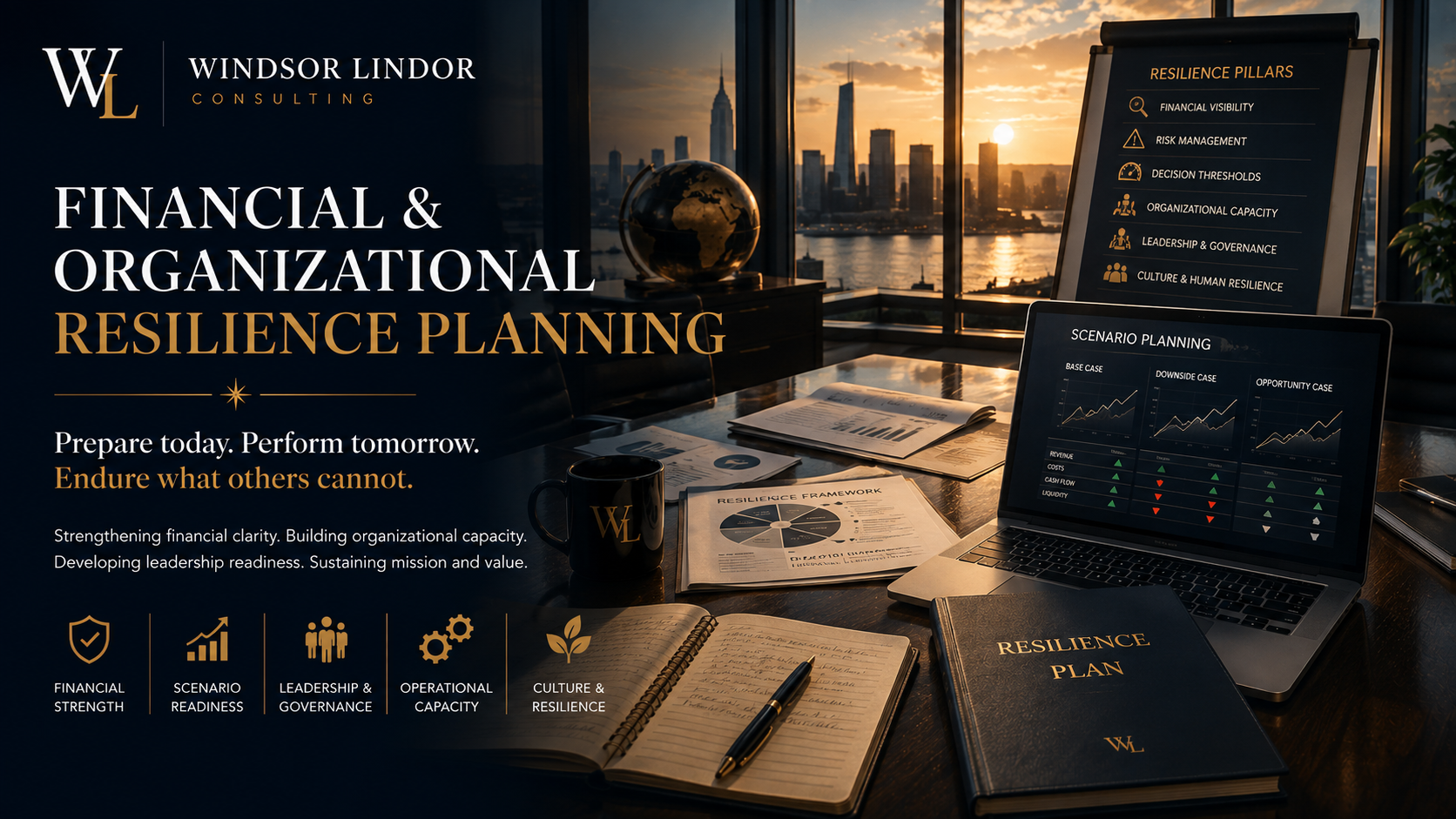
Financial & Organizational Resilience Planning
Build Resilience Before the Pressure Arrives.
A practical framework for strengthening financial clarity, organizational capacity, and leadership readiness across changing conditions.
Organizations cannot predict every disruption.
They can become better prepared to meet one.
Financial pressure, leadership transitions, economic uncertainty, unexpected growth, workforce constraints, operational disruption, and changing stakeholder expectations can expose weaknesses that remain largely invisible during stable periods.
Resilience planning helps leaders examine those vulnerabilities before circumstances force the examination.
This resource offers a practical way to think about the financial, organizational, operational, and human conditions that allow an organization to remain coherent when circumstances change.
Because resilience is not simply the ability to survive disruption.
It is the capacity to remain clear enough to make sound decisions while moving through it.
THE CHALLENGE
Pressure Rarely Creates Organizational Weakness. It Reveals It.
When conditions are favorable, organizations can carry inefficiencies for surprisingly long periods.
Unclear responsibilities remain manageable.
Decision-making bottlenecks are tolerated.
Cash-flow vulnerabilities remain hidden.
Processes depend heavily on a few individuals.
Leadership teams postpone difficult conversations.
Growth can even disguise structural weakness because increasing activity creates the appearance of organizational health.
Then circumstances change.
Revenue contracts.
A key leader leaves.
Costs increase.
Demand rises faster than capacity.
A major client is lost.
Technology fails.
A board confronts an unexpected fiduciary question.
An organization that appeared stable suddenly discovers how much of that stability depended upon conditions remaining predictable.
This is why resilience planning should begin before a crisis.
The objective is not to eliminate uncertainty.
It is to understand what must remain strong when uncertainty arrives.
THE PHILOSOPHY
Resilience Is Not a Spreadsheet. It Is an Operating Capacity.
Financial reserves matter.
Forecasting matters.
Insurance matters.
Contingency plans matter.
Yet none of them, independently, creates organizational resilience.
A financially prepared organization can still struggle if decision authority is unclear.
A well-capitalized business can become vulnerable when leadership avoids difficult choices.
A strong strategic plan can fail when the organization lacks the people or operational capacity to execute it.
A capable leadership team can lose effectiveness when pressure begins eroding trust, communication, and judgment.
For this reason, Windsor Lindor Consulting views resilience as a living organizational system.
Financial strength, leadership judgment, organizational capacity, operational discipline, culture, governance, and human behavior interact continuously.
A weakness in one can place pressure on the others. Strength across them creates options. That distinction matters.
Resilience is not merely having enough resources to absorb difficulty.
It is having enough clarity, capacity, discipline, and adaptability to respond intelligently as conditions change.
“Resilience is not about avoiding risk. It is about developing the clarity and capacity to know when and how to act.”
— Windsor Lindor
The following framework provides leaders, boards, and organizations with a practical way to examine resilience before pressure makes the assessment unavoidable.
THE RESILIENCE ARCHITECTURE
Six Dimensions of an Organization Built to Endure
01 | Financial Visibility
Resilient organizations understand their financial position beyond the current balance.
Leadership should be able to see:
Cash position and liquidity
Fixed and variable cost structures
Revenue concentration
Financial dependencies
Reserve capacity
Critical financial commitments
Emerging cost pressures
Financial thresholds requiring intervention
The central question is not simply:
How are we performing today?
It is:
How long can our current structure remain viable if conditions change?
02 | Scenario Readiness
Forecasting often assumes that the future will resemble what leadership expects. Resilience planning asks what happens when it does not.
A practical scenario framework examines at least three conditions:
Base Case
What happens if present assumptions remain reasonably stable?Downside Case
What happens if revenue declines, costs rise, capacity contracts, or another material disruption occurs?Opportunity Case
What happens if demand, funding, market opportunity, or organizational growth accelerates faster than expected?
Scenario planning is not prediction.
It is rehearsal.
The purpose is to reduce the amount of strategic thinking that must occur for the first time while pressure is already high.
03 | Decision Thresholds
Organizations frequently lose valuable time during uncertainty because leadership has not established the conditions that should trigger action.
Resilience improves when important thresholds are identified in advance.
Examples may include:
Minimum liquidity levels
Revenue decline thresholds
Staffing ratios
Client concentration exposure
Capacity limits
Cost escalation levels
Performance deterioration
Compliance or governance concerns
Conditions requiring board involvement
A threshold transforms an abstract concern into a decision point.
Instead of asking, “Should we be worried yet?”
Leadership can ask:
“The condition we agreed would require action has occurred. What decision now follows?”
That is a fundamentally stronger operating position.
04 | Organizational Capacity
Financial resources alone cannot carry an organization through complexity.
People, systems, processes, technology, leadership bandwidth, and institutional knowledge determine how much pressure the organization can absorb.
Leaders should understand:
Where critical knowledge resides
Which functions depend excessively on one person
Where succession vulnerabilities exist
Which processes create recurring friction
Whether staffing reflects actual priorities
Where technology creates resilience or dependency
Which capabilities would become constrained first during disruption or rapid growth
Capacity planning asks a deceptively simple question:
What would break first if conditions changed significantly tomorrow?
The answer often identifies where resilience work should begin.
05 | Leadership & Governance Readiness
Pressure compresses decision time. That makes leadership architecture increasingly important.
Organizations become more resilient when there is clarity around:
Who has authority to make which decisions
What requires executive approval
What requires board oversight
How emerging risks are escalated
How competing priorities are resolved
How stakeholders receive critical information
What values remain non-negotiable during difficult decisions
For governing boards, resilience also requires stewardship.
The board's responsibility extends beyond responding to immediate financial performance. It includes asking whether the organization possesses the leadership, governance, reserves, systems, and strategic capacity required to fulfill its mission over time.
This is where Organizational Stewardship™ becomes practical.
Stewardship asks leaders to consider not only:
What decision solves today's problem?
It also asks:
What decision leaves the organization stronger for what comes next?
06 | Culture & Human Resilience
Every resilience plan eventually depends upon people. During uncertainty, leaders and teams experience pressure differently.
Communication can narrow.
Fear can distort judgment.
Trust can weaken.
People may protect departments instead of protecting the organization.
Leaders may become reactive precisely when thoughtful leadership is most necessary.
Emotional intelligence therefore belongs inside organizational resilience planning.
Healthy cultures make it possible to:
Surface difficult information earlier
Disagree without fragmenting relationships
Communicate uncertainty responsibly
Maintain accountability under pressure
Adapt without abandoning values
Make difficult decisions while preserving dignity
Recover and learn after disruption
Financial resilience protects resources. Organizational resilience protects capacity.
Human resilience protects the quality of judgment through which both are stewarded.
A practical resilience architecture may include:
Financial Guardrails
Establish liquidity thresholds, reserve principles, cost controls, and financial decision parameters before urgency determines them.
Scenario Planning
Develop realistic base, downside, and opportunity scenarios connected to specific leadership responses.
Risk Visibility
Create a disciplined view of financial, operational, leadership, governance, technology, people, and strategic vulnerabilities.
Decision Architecture
Clarify authority, escalation paths, decision thresholds, and accountability.
Capacity Planning
Examine whether people, processes, systems, technology, and financial resources can support changing demands.
Leadership Readiness
Strengthen executive judgment, communication, emotional intelligence, and decision-making under uncertainty.
Governance Readiness
Ensure boards understand emerging risks, organizational dependencies, financial exposure, and long-term stewardship responsibilities.
Recovery & Learning
Determine how the organization will assess disruption, capture lessons, and strengthen systems afterward.
The purpose is not to create another binder.
It is to make sound decision-making more repeatable when conditions become less predictable.
CAPABILITY
From Resilience Thinking to Resilience Architecture
Understanding resilience is valuable.
Operationalizing it requires structure.
BODY OF WORK
Resilience Is Part of a Larger Leadership Architecture.
Financial and organizational resilience does not stand apart from the broader work of leadership.
It intersects directly with the intellectual and advisory frameworks that shape Windsor Lindor Consulting.
Organizational Stewardship™
Strengthening the capacity of boards and executive leaders to protect purpose, institutional integrity, resources, and long-term viability.
Systems-Aligned Leadership™
Aligning leadership, strategy, people, culture, decision-making, and operating systems so the organization can respond coherently rather than fragment under pressure.
Culture of Success™
Creating conditions in which values, accountability, trust, emotional intelligence, and disciplined execution reinforce one another.
Adaptive Coaching for Stretch Goals™
Helping leaders develop the emotional, strategic, and behavioral capacity required to pursue consequential outcomes while adapting intelligently to changing conditions.
Inner Architecture™
Strengthening the values, emotional intelligence, awareness, and character from which leaders interpret uncertainty and make consequential decisions.
Together, these frameworks reinforce one central principle:
Organizations become more resilient when the people, systems, and structures responsible for carrying them become stronger together.
IDEAS IN ACTION
A Practical Resilience Conversation for Leadership Teams
Resilience planning does not have to begin with a major consulting initiative.
It can begin with better questions.
Gather the executive team or governing board and work through the following conversation.
Financial
If revenue declined materially for the next six months, what decisions would become necessary first?
Operational
Which process, system, vendor, or individual currently represents our greatest operational dependency?
Leadership
Which important decisions would become unclear if our CEO, executive director, founder, or another key leader became unavailable tomorrow?
Governance
What emerging risk deserves greater board visibility today rather than six months from now?
People
Where are we operating with insufficient capacity, unclear accountability, or excessive dependence on individual effort?
Culture
When pressure rises, what happens to the quality of our communication, trust, and decision-making?
Strategy
Which commitments remain essential even if circumstances require us to change how we pursue them?
Recovery
After the last significant disruption, what did we actually change?
Do not rush to answer every question.
The value begins with seeing the organization more clearly.
RESILIENCE PLANNING FRAMEWORK
Four Questions Worth Keeping Visible
When circumstances become uncertain, leadership can return to four questions:
What must we protect?
Purpose. People. Liquidity. Trust. Critical operations. Institutional integrity.
What must we understand?
Risk. Capacity. Dependencies. Financial exposure. Decision authority. Changing conditions.
What must we be willing to change?
Assumptions. Costs. Priorities. Structures. Processes. Timelines. Previous plans.
What must remain true about how we lead?
Values. Integrity. Accountability. Communication. Stewardship. Respect for the people affected by our decisions.
These questions create a practical bridge between resilience planning and leadership behavior.
A SELF-ASSESSMENT
How Resilient Is Your Organization Today?
Consider each statement honestly.
Financial
We understand our liquidity and financial thresholds.
We know how long current reserves could support essential operations under different scenarios.
Leadership understands where financial concentration or dependency exists.
Operational
Critical processes are documented sufficiently to survive personnel changes.
We understand our most important operational dependencies.
Our systems can adapt to meaningful increases or decreases in demand.
Leadership
Decision authority is clear.
Important risks are escalated early.
Leadership can make difficult decisions without allowing urgency to replace judgment.
Governance
The board receives the information necessary for meaningful stewardship.
Governance responsibilities remain clear during periods of uncertainty.
Long-term resilience receives attention alongside immediate performance.
Culture
Difficult information can move upward without fear.
Accountability remains intact under pressure.
Our values continue influencing decisions when circumstances become difficult.
Areas that create hesitation deserve attention.
Not because weakness should create alarm. Because visibility creates options.
IDEAS FOR CONTINUED EXPLORATION
Resilience Is a Discipline of Continuous Learning.
Financial and organizational resilience connects naturally to a larger set of leadership questions:
How should organizations prepare for uncertainty without becoming overly cautious?
What distinguishes prudent reserves from unused capacity?
How should boards evaluate organizational resilience?
How does emotional intelligence affect executive judgment during crisis?
When does operational efficiency begin creating fragility?
How should leaders balance immediate financial pressure with long-term organizational health?
What does responsible stewardship require during contraction?
How can organizations grow without allowing complexity to outpace capacity?
These questions will continue to be explored through Windsor Lindor Consulting's Leadership Resources, Leadership Reflections, executive lectures, articles, and Organizational Stewardship work.
CONSULTATION
When Resilience Requires More Than Reflection.
A resource can help leadership see the organization differently.
There are also moments when the questions become sufficiently consequential that an independent strategic perspective is useful.
Perhaps growth is beginning to outpace capacity.
Financial pressure is narrowing strategic options.
The board needs greater visibility into organizational risk.
Leadership responsibilities are unclear.
A transition is exposing dependencies that were previously manageable.
Or the organization is healthy today and leadership simply recognizes the responsibility to prepare before conditions change.
Those are appropriate moments for a strategic conversation.
Windsor Lindor Consulting works with executives, entrepreneurs, governing boards, nonprofit organizations, and mission-driven businesses to examine the relationships among leadership, strategy, governance, organizational capacity, financial discipline, culture, and long-term resilience.
The conversation begins with understanding the system before prescribing a solution.
Build What Endures.
Windsor Lindor
Strategic Consultant | Executive Coach | Life Coach
Architect of Systems-Aligned Leadership & Organizational Clarity
Results-Driven. Human-Centered. Systems-Aligned.™