
Transformational Leadership Coaching
The Leader You Become Shapes What Your Leadership Can Sustain.
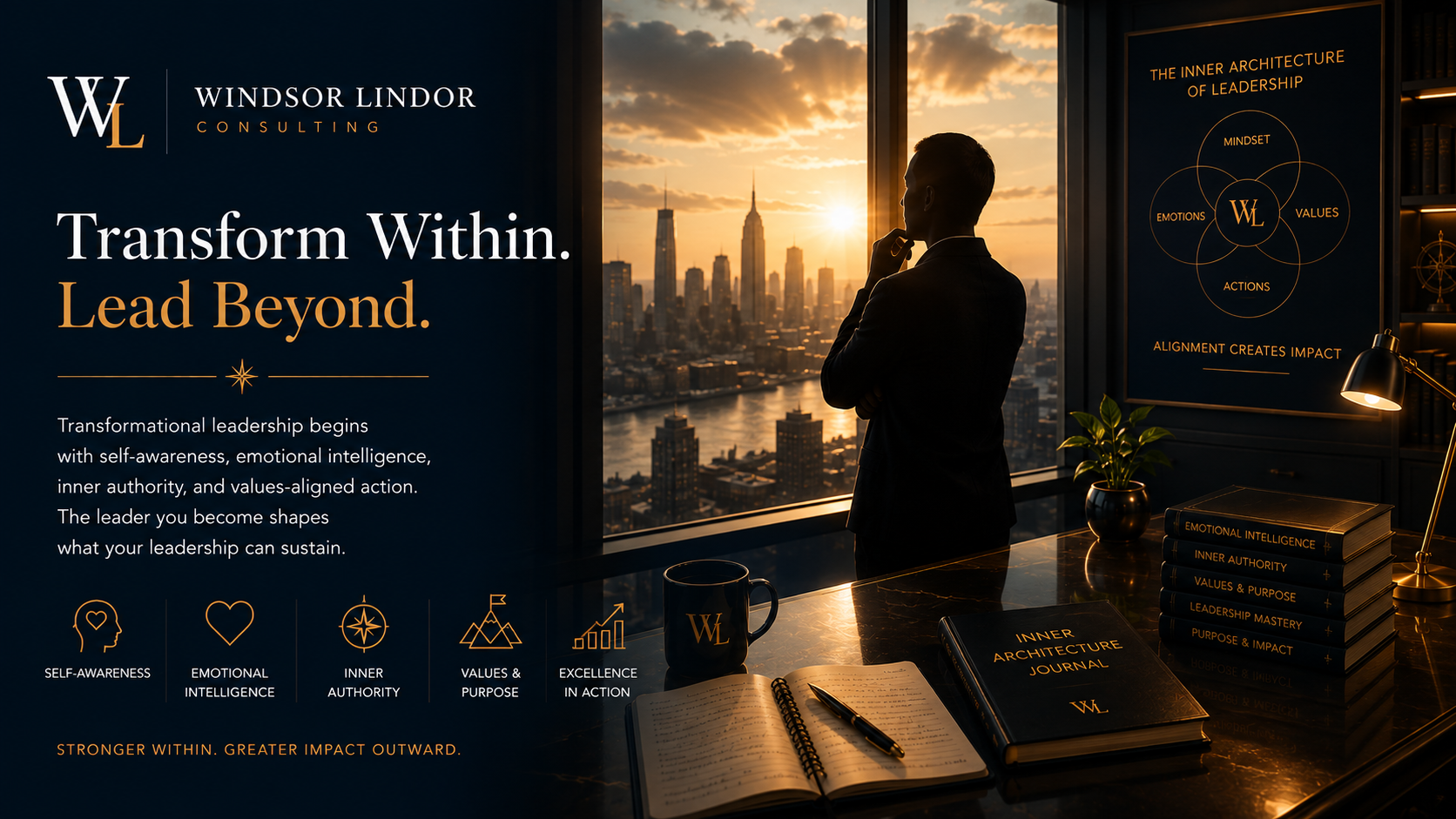
Transformational leadership begins within: strengthening the emotional intelligence, self-awareness, inner authority, and human capacity from which meaningful leadership emerges.
Leadership is often measured by what can be seen: decisions made, people influenced, strategies executed, and results achieved.
Yet beneath every visible expression of leadership is an invisible architecture.
Our beliefs shape interpretation. Our emotional patterns influence communication. Our values affect judgment. Our relationship with authority influences how we exercise it. Our self-awareness determines whether pressure produces thoughtful response or unconscious reaction.
Transformational Leadership Coaching explores this deeper developmental territory.
It moves beyond improving leadership technique to examine the human being from whom leadership emerges.
Because sustainable transformation is not simply about learning to lead differently.
It is about developing the person capable of carrying leadership differently.
CHALLENGE
Leadership Can Outgrow the Person Who First Learned to Carry It.
Growth creates an often-overlooked leadership paradox.
The qualities that helped someone reach one level of responsibility may not be sufficient for the next.
An entrepreneur becomes responsible for people rather than only ideas.
A technically accomplished professional becomes responsible for judgment, culture, and trust.
An executive discovers that greater authority does not automatically create greater clarity.
A leader accustomed to succeeding through intensity may discover that the same intensity is beginning to affect relationships, communication, or decision quality.
External achievement may continue advancing while the internal architecture supporting it becomes increasingly strained.
This does not necessarily indicate failure.
It may indicate development.
Responsibility has expanded beyond the capacity that was originally developed to carry it.
Transformational leadership begins when we become willing to examine that gap.
PHILOSOPHY
Leadership Is Developed From the Inside Out.
A foundational philosophy of Windsor Lindor Consulting is:
Leadership is the visible evidence of an invisible architecture™.
How leaders communicate, decide, respond to uncertainty, receive criticism, establish boundaries, navigate conflict, exercise authority, and influence culture is rarely separate from their internal condition.
Beliefs influence interpretation.
Interpretation influences emotion.
Emotion influences behavior.
Behavior influences relationships.
Relationships influence trust.
Trust influences what becomes possible within a human system.
Leadership development therefore cannot be reduced to acquiring another technique.
Technique can modify behavior.
Transformation asks something deeper:
What internal architecture continues producing the behavior?
This question brings leadership development into direct relationship with Human Development.
It invites examination of emotional intelligence, values, identity, responsibility, belief systems, purpose, adaptation, and the relationship between intention and impact.
The objective is not perfection.
The objective is coherence: greater alignment among what we believe, what we value, how we behave, and the influence our behavior creates.
CAPABILITY
The Five Capacities of Transformational Leadership
01 | Self-Awareness
Transformation begins with learning to observe ourselves accurately.
Self-awareness helps us recognize:
assumptions beneath decisions
recurring emotional reactions
patterns activated under pressure
differences between intention and impact
inherited beliefs
strengths that become liabilities when overused
places where identity has become attached to achievement, control, or approval
Self-awareness creates space between experience and reaction.
Its central question is:
What within me is influencing how I am interpreting this moment?
02 | Emotional Intelligence
Emotional intelligence converts awareness into relational and leadership capacity.
It strengthens our ability to recognize emotion without automatically surrendering judgment to it.
For leaders, this affects:
Decision-making
Communication
Conflict
Empathy
Boundaries
Adaptability
Trust
Relationships
Organizational culture
Emotional intelligence is not emotional suppression.
It is a more intelligent relationship with emotion.
A leader gradually becomes better able to distinguish:
What am I feeling?
from
What does this situation require of me?
That distinction can materially change a decision.
03 | Responsibility & Authorship
Transformational development requires responsibility without unnecessary self-condemnation.
We cannot control every circumstance, another person's behavior, economic conditions, organizational politics, or everything that enters our lives.
We remain responsible for how consciously we interpret, respond, communicate, choose, and act within those conditions.
This is authorship.
It moves us from:
Why is this happening to me?
toward:
What responsibility is mine within what is happening?
Responsibility does not deny circumstance.
It restores agency within circumstance.
04 | Inner Authority
Leadership eventually requires the capacity to think and choose without being governed primarily by external approval.
Inner authority develops as values, discernment, emotional intelligence, and responsibility become increasingly integrated.
It strengthens our ability to:
Say no when necessary
Remain thoughtful during disagreement
Receive counsel without surrendering judgment
Make difficult decisions responsibly
Recognize when fear is masquerading as prudence
Distinguish conviction from ego
Remain aligned through uncertainty
Inner authority is not dominance.
It is grounded self-governance.
05 | Excellence in Action
Insight becomes transformational when it changes behavior.
We may understand emotional intelligence intellectually and still react destructively under pressure.
We may know our values while repeatedly compromising them through avoidance.
We may recognize a pattern and continue reproducing it.
Transformation therefore requires a question that moves insight into life:
What behavior would make this awareness visible?
The answer may be a conversation.
A boundary.
A decision.
An apology.
A different response.
A discipline.
A commitment completed rather than contemplated.
This is Excellence in Action: the movement from awareness into values-aligned behavior.
THE INNER ARCHITECTURE
What Are You Leading From?
Consider two executives preparing for the same difficult conversation.
One enters carrying fear of rejection, accumulated frustration, and an unresolved need to establish authority.
The other may experience many of the same emotions.
The difference is awareness.
The second leader recognizes what is happening internally, returns to purpose, clarifies the boundary that matters, and prepares to listen without surrendering responsibility.
The external circumstance may be identical.
The internal architecture is different.
That difference changes what each leader notices, how each communicates, and what each makes possible.
This is why self-leadership precedes sustainable leadership of others.
We influence every human system through the condition from which we enter it.
IDEAS IN ACTION
From Reaction to Conscious Choice
This is where the resource becomes immediately useful.
A practical discipline for transformational leadership is:
NOTICE
What is happening within me?
Identify the emotion, assumption, physical response, or internal narrative without immediately judging it.
EXAMINE
What is actually true?
Separate observable facts from interpretation, expectation, fear, projection, and assumption.
ALIGN
What matters here?
Return to values, purpose, responsibility, relationships, and the outcome that deserves protection.
CHOOSE
What response reflects the person and leader I intend to be?
This sequence may unfold in seconds during an ordinary interaction.
More consequential situations may require reflection, counsel, or additional time.
Its purpose is not to eliminate emotion.
It is to prevent unconscious emotion from becoming unexamined action.
BODY OF WORK
Transformational Leadership Within a Larger Developmental Philosophy
Transformational Leadership Coaching belongs to a larger body of work developed through more than two decades of consulting, executive advisory, coaching, leadership development, project leadership, teaching, writing, and reflective practice.
Adaptive Coaching for Stretch Goals™
How people grow.
A developmental methodology for pursuing consequential goals while strengthening the emotional, behavioral, and strategic capacity required to carry them.
Explore Adaptive Coaching for Stretch Goals™
Culture of Success™
How leaders live and organizations perform. A philosophy connecting values, emotional intelligence, relationships, accountability, purpose, and disciplined action.
Explore Culture of Success™
Organizational Stewardship™
How organizations endure, adapt, and fulfill their mission over time.
A philosophy of responsible leadership concerned with governance, institutional integrity, resilience, purpose, and the responsibility to leave organizations stronger than we found them.
Explore Organizational Stewardship™
Systems-Aligned Leadership™
Examines the relationship among leadership, strategy, people, culture, organizational structure, and operating systems.
Inner Architecture™
Explores the beliefs, values, emotional patterns, identity, awareness, and character from which leadership and human behavior emerge.
These frameworks examine different dimensions of development while reinforcing a common principle:
Sustainable external change requires sufficient internal capacity to carry it.
PRACTICAL SELF-REFLECTION
Bring the Framework Into One Leadership Challenge.
Select one current situation that continues to create friction, consume attention, or reproduce a familiar response.
Then examine it through five questions.
Awareness
What am I noticing about myself in this situation?Emotion
What emotion is influencing how I interpret what is happening?Belief
What assumption am I treating as fact?Responsibility
What genuinely belongs to me within this situation?Action
What values-aligned behavior would demonstrate greater leadership maturity?
Do not rush toward an answer.
The value of these questions is not that they make complexity disappear.
They help create a more intelligent place from which to meet it.
THE HUMAN DIMENSION
The Person and the Leader Cannot Be Completely Separated.
Leadership development is sometimes discussed as though our professional identity exists independently from the rest of life.
Human beings are not organized that way. How we relate to uncertainty professionally may resemble how we relate to uncertainty personally.
Our relationship with achievement can influence ambition and wellbeing.
Our ability to establish boundaries affects leadership and relationships.
Unresolved conflict consumes attention. Values create coherence across multiple dimensions of life.
This does not mean every personal matter belongs in a professional environment.
It means sustainable leadership development recognizes the whole human being carrying the responsibility.
Transformational development can therefore influence not only how someone leads an organization, but also how they communicate, establish boundaries, navigate transition, relate to others, make decisions, and define meaningful success.
CONTINUED EXPLORATION
Questions Worth Carrying Forward
Transformational leadership opens larger questions that deserve more than quick answers:
What happens when professional achievement develops faster than personal capacity?
How do unconscious assumptions influence executive judgment?
What is the relationship between emotional intelligence and authority?
How do we distinguish authentic conviction from ego?
Why do intelligent people continue repeating patterns they consciously understand?
How does identity influence resistance to change?
What does success require from the person entrusted to carry it?
These questions belong to the continuing work of Human Development.
Resource Pathways
CONSULTATION
When Insight Reveals That Something Must Change.
A resource can create awareness.
There are moments when awareness reveals work that deserves deeper attention. You may have reached a level of responsibility that requires a different way of leading.
Professional achievement may no longer feel sufficient as the primary measure of meaningful success.
A recurring emotional or relational pattern may be influencing your leadership.
A transition may be asking something different of you.
Or nothing may be fundamentally wrong.
You may simply recognize that the person responsible for carrying what comes next deserves intentional development.
Windsor Lindor Consulting works with executives, entrepreneurs, professionals, couples, and individuals through Human Development, Executive & Life Coaching, and Adaptive Coaching for Stretch Goals™.
The purpose is not to manufacture another version of you.
It is to strengthen the awareness, emotional intelligence, values, inner authority, and capacity for action from which you can lead your responsibilities and your life with greater coherence.
Build What Endures.
Windsor Lindor
Strategic Consultant | Executive Coach | Life Coach
Architect of Systems-Aligned Leadership & Organizational Clarity
Results-Driven. Human-Centered. Systems-Aligned.™