
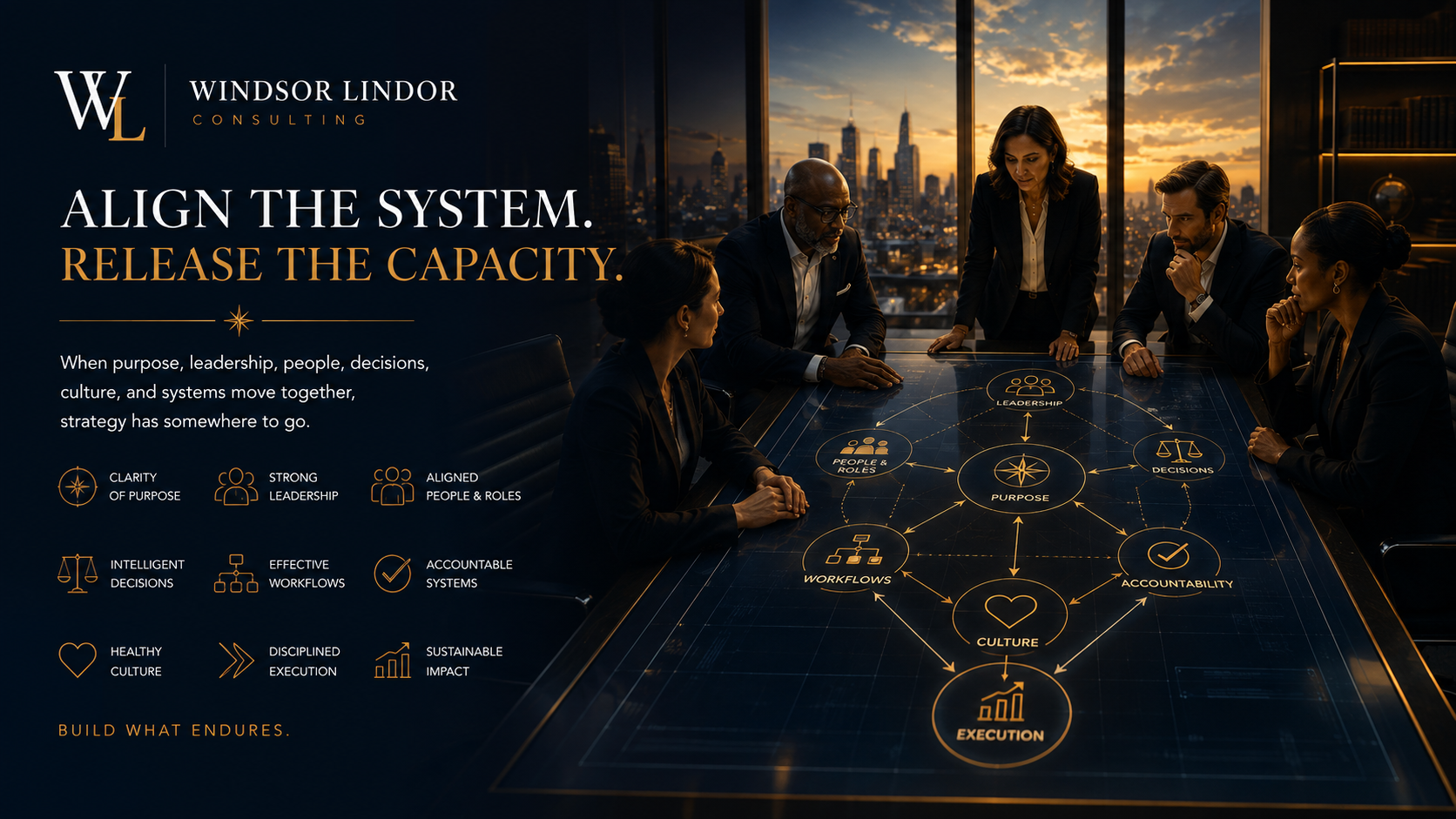
Align the System. Release the Capacity.
When purpose, leadership, people, decisions, culture, and operating systems move coherently, strategy has somewhere to go.
Organizations rarely struggle because everyone has stopped caring.
More often, capable people are working inside systems that no longer support what the organization is asking them to accomplish.
Decisions become slower. Responsibilities overlap. Processes accumulate. Leaders compensate for structural weaknesses through personal effort. Strategy and daily operations begin moving at different speeds. Culture says one thing while organizational systems reinforce another.
These conditions create friction that can easily be mistaken for a people problem.
Systems Alignment offers another way of seeing the organization.
It examines whether the relationships among purpose, leadership, people, structure, decisions, processes, accountability, and culture are sufficiently coherent to support the work the organization is responsible for carrying.
Sustainable execution does not come from asking people to compensate indefinitely for a misaligned system.
It comes from creating conditions in which good leadership and good work can move through the organization with less unnecessary resistance.
THE CHALLENGE
Organizational Friction Is Often a Systems Signal.
Misalignment rarely announces itself as one obvious problem.
It appears as organizational drag.
A decision repeatedly returns to the same executive.
Two capable people believe they own the same responsibility.
A leadership team agrees on strategy, yet execution remains inconsistent.
Meetings multiply because decision rights remain unclear.
Employees develop workarounds because formal processes no longer reflect how work actually happens.
Values appear prominently in organizational communications while incentives quietly reward contradictory behavior.
Leaders compensate by working longer, intervening more frequently, and becoming increasingly involved in matters the system should be capable of carrying.
Eventually, the organization may conclude that it has a performance problem.
Sometimes it does.
At other times, performance is simply where systemic incoherence becomes visible.
The first question should therefore not always be:
Who is failing?
A more intelligent question may be:
What within the system is making effective performance unnecessarily difficult?
That question changes the quality of organizational diagnosis.
THE PHILOSOPHY
Alignment Before Optimization.
Organizations frequently respond to friction by attempting to improve individual components.
Change the workflow.
Replace the technology.
Add another policy.
Restructure the team.
Create another KPI.
Hire another manager.
Each intervention may have merit.
Yet optimizing one part of a misaligned system can simply make the misalignment operate faster.
Systems thinking requires a broader perspective.
Windsor Lindor Consulting approaches alignment through a fundamental principle:
An organization should operate as an interconnected human system, not as a collection of independently optimized parts.
Leadership affects culture.
Culture affects behavior.
Behavior affects execution.
Structure influences authority.
Authority influences decisions.
Decisions influence resources.
Processes influence accountability.
Technology influences workflow.
Purpose should provide coherence across all of them.
This distinction matters.
Efficiency asks whether we can do something with less waste.
Alignment asks whether the right things are connected in the right way to fulfill the organization's purpose.
Both matter.
Alignment comes first.
CAPABILITY
The Six Dimensions of Systems Alignment
-
Every organizational system needs a governing reference point.
That reference point begins with purpose translated into strategic priorities.
Leadership should be able to answer:
What are we responsible for accomplishing?
What matters most now?
What are we deliberately not prioritizing?
What principles guide difficult tradeoffs?
How does today's work contribute to longer-term direction?
When purpose remains abstract, teams create their own interpretations of priority.
Alignment begins with sufficient clarity about what the organization is actually trying to accomplish.
-
A title does not necessarily create role clarity.
Healthy organizational structures make responsibility visible.
People should understand:
What they own
What they influence
What they support
What belongs elsewhere
Where accountability begins and ends
How their role contributes to the larger system
Role ambiguity creates duplication, avoidance, conflict, unnecessary escalation, and leadership bottlenecks.
The objective is not rigid hierarchy.
It is clarity sufficient for responsible action.Description text goes here
-
One of the most expensive forms of organizational friction is decision ambiguity.
Who recommends it?
Who contributes?
Who decides?
Who executes?
Who must be informed?
When these distinctions remain unclear, decisions circulate rather than move.
Senior leaders become bottlenecks. Teams hesitate. Accountability weakens because responsibility and authority become separated.
Aligned organizations establish decision architecture appropriate to the significance of the decision.
A useful governing question is:
Is authority located close enough to the knowledge required to make the decision while maintaining the oversight necessary to protect the organization?
This is where systems alignment intersects with governance and Organizational Stewardship™.
-
Organizations do not operate primarily through organizational charts.
They operate through recurring movements of work.
Information moves.
Decisions move.
Client needs move.
Resources move.
Problems escalate.
Commitments are reviewed.
Teams coordinate.
Systems Alignment examines whether these movements are deliberate or dependent upon individual memory, informal relationships, and repeated executive intervention.
A healthy operating rhythm creates predictable mechanisms for:
Communication
Coordination
Decision-making
Escalation
Accountability
Performance review
Strategic review
Organizational learning
The objective is not more meetings.
It is less uncertainty about how important work moves.
-
Accountability becomes sustainable when expectations, authority, information, resources, and feedback reinforce one another.
A person cannot reasonably be accountable for an outcome they lack sufficient authority or resources to influence.
Likewise, responsibility without feedback creates delayed learning.
Aligned accountability asks:
What result matters?
Who owns it?
What authority accompanies that ownership?
How will progress become visible?
When and how will the organization review what is happening?
Metrics then become useful because they support judgment rather than substitute for it.
Accountability becomes part of organizational learning rather than merely performance control.
-
Every formal organizational system operates within a human system.
People interpret policies.
Relationships influence communication.
Trust affects whether difficult information travels upward.
Leadership behavior determines whether stated values become credible.
Culture therefore cannot be separated from systems design.
If an organization says collaboration matters while incentives reward internal competition, the system communicates more powerfully than the values statement.
If leadership says accountability matters while consistently avoiding difficult conversations, people learn what accountability actually means.
Culture becomes operational when:
Values → Behaviors → Decisions → Reinforcement → Accountability
begin pointing in the same direction.
That is where culture moves from aspiration into organizational practice.
THE SYSTEMS-ALIGNED ORGANIZATION
Coherence Is the Objective.
The goal of Systems Alignment is not perfection.
Organizations are living systems.
People change.
Markets change.
Leadership changes.
Strategies evolve.
Technology develops.
Unexpected conditions emerge.
A perfectly optimized organization for yesterday can become poorly aligned for tomorrow.
Alignment must therefore remain adaptive.
The objective is to create sufficient coherence that an organization can recognize changing conditions and adjust without losing its purpose.
This is where Systems-Aligned Leadership™ becomes important.
Leaders are not simply responsible for operating inside organizational systems.
They continually shape them.
Every repeated workaround, unresolved ambiguity, leadership exception, informal decision path, and tolerated contradiction teaches the organization how it actually operates.
Over time, systems become reflections of repeated leadership choices.
When leaders continually compensate for a weak system, the organization can mistake leadership effort for organizational capacity.
A stronger organization develops systems capable of carrying responsibility without requiring constant executive rescue.
IDEAS IN ACTION
A Practical Systems Alignment Diagnostic
Before redesigning a system, leaders should first learn to see it.
Choose one recurring organizational frustration.
Perhaps a decision takes too long.
A process repeatedly breaks.
Two functions continue conflicting.
A senior executive remains unnecessarily involved.
Accountability repeatedly becomes unclear.
Then examine it through six questions.
PURPOSE
What outcome is this system supposed to support?
OWNERSHIP
Who is genuinely responsible for that outcome?
AUTHORITY
Does that person possess sufficient authority to act?
FLOW
How does information, work, or decision-making move through the system?
FRICTION
Where does unnecessary resistance, duplication, delay, or ambiguity occur?
REINFORCEMENT
What behavior is the current system actually encouraging?
Do not redesign immediately.
First understand why the current system behaves as it does.
Good systems diagnosis precedes good systems design.
FROM SYMPTOM TO SYSTEM
Look Beneath the Presenting Problem.
A useful systems discipline moves through four levels.
EVENT
What happened?
A deadline was missed.
PATTERN
Where else is this happening?
Similar deadlines have been missed across several projects.
STRUCTURE
What conditions make the pattern more likely?
Ownership changes during execution, dependencies remain unclear, and escalation occurs too late.
SYSTEM
What relationships among leadership, process, incentives, information, authority, and accountability continually reproduce those conditions?
Now the organization is examining architecture rather than symptoms.
Repeatedly correcting events without examining the system can produce an organization that becomes highly proficient at solving the same problem.
BODY OF WORK
Systems Alignment Within a Larger Organizational Philosophy
Systems Alignment belongs to the broader intellectual architecture of Windsor Lindor Consulting.
Adaptive Coaching for Stretch Goals™
How people grow.
Developing the human capacity required to carry increasingly consequential goals and responsibilities.
Culture of Success™
How leaders live and organizations perform.
Connecting values, emotional intelligence, relationships, accountability, purpose, and disciplined action.
Systems-Aligned Leadership™
How leadership and organizational systems become coherent.
Connecting leadership behavior with strategy, structure, people, culture, processes, accountability, and execution.
Organizational Stewardship™
How organizations endure, adapt, and fulfill their mission over time.
Extending leadership responsibility beyond immediate performance toward governance, resilience, institutional integrity, purpose, and long-term capacity.
Together, these ideas reveal a larger developmental progression:
People Develop.
Leadership Aligns.
Systems Reinforce.
Culture Embodies.
Organizations Endure.
Systems Alignment therefore is not simply process optimization.
It is one dimension of building organizational capacity that can endure.
SYSTEMS ALIGNMENT SELF-ASSESSMENT
Where Is Your Organization Carrying Unnecessary Friction?
Use these questions with an executive team, leadership team, or governing board.
Strategic Alignment
Are strategic priorities sufficiently clear to guide tradeoffs?
Do teams understand how their work contributes to those priorities?
Are competing priorities deliberately resolved?
Structural Alignment
Are roles and responsibilities sufficiently clear?
Does important work routinely fall between functions?
Are accountability and authority appropriately connected?
Decision Alignment
Do people understand who owns consequential decisions?
Are decisions made at an appropriate organizational level?
Does unnecessary ambiguity repeatedly reach senior leadership?
Operational Alignment
Are critical workflows understood?
Are escalation paths clear?
Do meetings and reporting rhythms support decisions rather than merely circulate information?
Cultural Alignment
Does leadership behavior reinforce stated values?
Is accountability practiced consistently?
Can difficult information travel through the organization without unnecessary fear or distortion?
Learning Alignment
Does the organization examine recurring problems rather than merely correcting incidents?
Does feedback result in system changes when appropriate?
Do lessons from execution influence future decisions?
Where hesitation appears, there may be useful work to examine.
Not every friction point requires redesign.
Every persistent friction point deserves understanding.
WHAT ALIGNMENT MAKES POSSIBLE
Less Organizational Drag. Greater Capacity for What Matters.
Systems Alignment should not promise a frictionless organization.
It creates conditions that can support:
Clearer Decisions
People better understand where authority resides and how decisions move.
Stronger Accountability
Responsibility becomes connected to authority, expectations, information, resources, and review.
Greater Leadership Capacity
Executives spend less time compensating for avoidable structural ambiguity.
More Coherent Execution
Strategy, processes, roles, decisions, and operating rhythms reinforce rather than compete with one another.
Greater Cultural Credibility
Organizational systems increasingly support the values leadership says matter.
Improved Adaptability
Leaders can recognize when existing structures no longer fit changing circumstances and adjust deliberately.
Healthy organizations still encounter disagreement, uncertainty, and complexity.
The distinction is that their systems help them work through complexity rather than continually reproduce it.
CONTINUED EXPLORATION
Systems Thinking Raises Better Leadership Questions.
Systems Alignment naturally opens larger questions:
What is the difference between role flexibility and role ambiguity?
How much decision authority should remain centralized?
When does operational efficiency create organizational fragility?
What happens when culture and incentives communicate different expectations?
How can leaders distinguish a people problem from a systems problem?
When should a process be improved, and when should it be eliminated?
How does organizational growth change the systems leadership requires?
What should remain stable when strategy changes?
These are not merely operational questions.
They concern leadership, culture, governance, resilience, and stewardship.
Continue Exploring
Financial & Organizational Resilience Planning
Explore how organizations strengthen readiness before changing conditions expose vulnerabilities.Organizational Stewardship™
Explore the responsibility to build organizations capable of enduring beyond immediate performance.Leadership Resources
Explore the broader Windsor Lindor Consulting body of thinking on leadership, Human Development, organizational effectiveness, and meaningful success.
CONSULTATION
When Organizational Friction Deserves a Deeper Examination.
A resource can help leaders recognize misalignment.
There are also moments when understanding the system benefits from a perspective outside it.
Growth may have outpaced organizational structure.
Decisions may repeatedly return to senior leadership.
Responsibilities may have become unclear.
A leadership transition may be exposing dependencies.
Strategy may be sound while execution remains inconsistent.
Culture and operating practices may be communicating different expectations.
Or the organization may be functioning reasonably well while leadership recognizes that its next stage will require a stronger architecture.
Those are appropriate moments for a strategic conversation.
Windsor Lindor Consulting works with executives, entrepreneurs, governing boards, leadership teams, nonprofit organizations, and mission-driven businesses to examine the relationships among leadership, strategy, structure, governance, people, culture, processes, accountability, and execution.
We begin by understanding the system before prescribing a solution.
Build What Endures.
Windsor Lindor
Strategic Consultant | Executive Coach | Life Coach
Architect of Systems-Aligned Leadership & Organizational Clarity
Results-Driven. Human-Centered. Systems-Aligned.™