
The Inner Authority We Carry Into Change
Change does not always arrive dramatically.
Sometimes it enters quietly through a conversation, a decision, a shift in responsibility, or the gradual recognition that a familiar way of living or leading no longer fits what the next season requires. At other times, change arrives with enough force to reorganize the landscape around us.
Roles shift. Relationships evolve. Expectations change. Systems are disrupted. Certainties become questions.
In either form, change reveals something important about leadership.
It reveals whether our sense of direction is anchored entirely in external conditions or whether we have developed an internal architecture capable of helping us remain thoughtful, emotionally present, and responsible while circumstances are being rearranged.
That distinction matters. Change may influence us. It may challenge us. It may even transform us. Yet it does not have to become the governing authority of our inner condition.
Conscious leadership begins with recognizing that there remains something within our stewardship: the quality of awareness, meaning, and action we bring into what is happening.
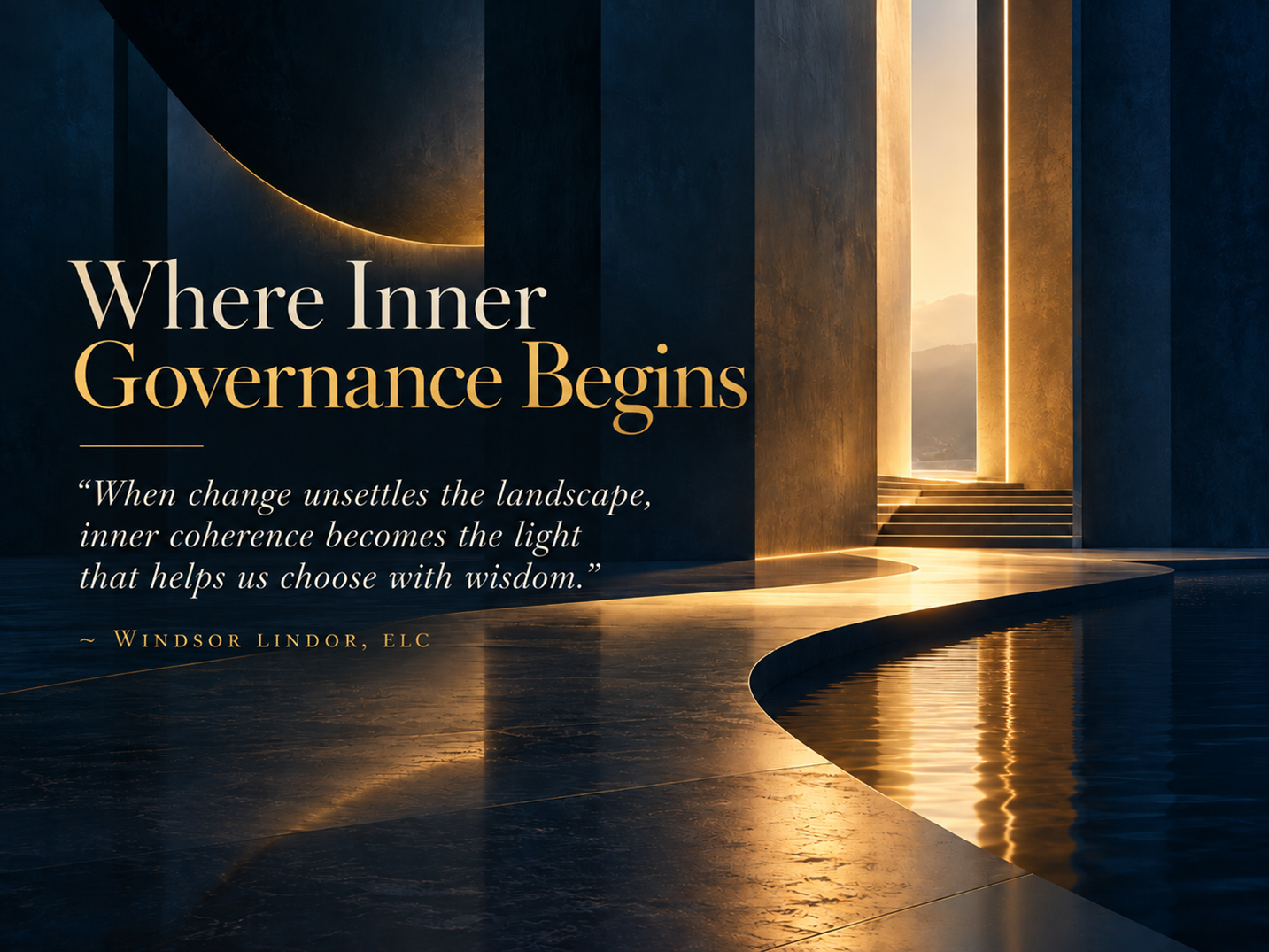
Deep Ocean Blue architectural passage illuminated by Soft Architectural Gold light, symbolizing inner governance, conscious leadership, clarity, and steadiness through change.
Change Reveals the Architecture Beneath Leadership
Much of the conversation about change focuses on external management.
Leaders are taught to create plans, communicate priorities, manage resistance, establish milestones, clarify roles, and measure progress. These disciplines are important. Yet there is another dimension of change that is often less visible. Change also confronts the internal architecture of the leader.
It exposes assumptions.
It activates emotion.
It reveals attachments.
It tests values.
It brings habitual responses closer to the surface.
Under pressure, leaders frequently discover whether they are responding from conscious judgment or reacting from patterns that have never been sufficiently examined. This is why steadiness should not be confused with emotional distance.
Steadiness is not the absence of feeling.
It is the capacity to remain in meaningful relationship with oneself, one’s values, and one’s responsibilities while conditions are moving.
A leader may experience uncertainty and still exercise clarity.
A leader may feel frustration and still communicate with dignity.
A leader may encounter fear and still make a disciplined decision.
Emotional intelligence becomes particularly important here because emotion is not merely something to suppress or overcome. Emotion carries information. The leadership question is what we do with that information.
Do we immediately convert feeling into reaction?
Do we allow anxiety to become urgency?
Do we permit pressure to determine tone?
Or can we pause long enough to interpret what we are experiencing within a wider context?
That pause matters because leadership is expressed not only through the decisions we make, but through the condition from which those decisions emerge. Leadership is, in many ways, the visible evidence of an invisible architecture.
Inner Authority Is Not the Same as Control
There is an important distinction between control and inner authority.
Control seeks command over external conditions.
Inner authority concerns the quality of our participation within those conditions.
The difference is consequential.
Leaders cannot control every market condition, employee reaction, organizational disruption, personal transition, or unexpected consequence.
Attempts to control what cannot be controlled often create additional rigidity, frustration, and unnecessary conflict.
Inner authority asks a different set of questions:
What is actually mine to govern?
What interpretation am I bringing to this situation?
What emotion is present, and what information does it contain?
What value should guide my next decision?
What responsibility belongs to me now?
These questions move leadership away from reflex and toward stewardship. Inner authority does not deny complexity.
It does not pretend that people operate independently of systems, relationships, histories, or pressures.
Instead, it recognizes that even within complexity, we retain some authorship over the meaning, character, and quality of our response.
That authorship becomes visible through choice.
A leader who practices inner authority may not be able to determine the circumstances of change, yet that leader can still decide how to enter the conversation, how to interpret incomplete information, how to hold accountability, how to communicate uncertainty, and how to preserve human dignity while making difficult decisions.
This is also where reverence becomes practical. Reverence in leadership is not passivity.
It is the recognition that decisions enter a living field of relationships, consequences, and meaning.
Without reverence, authority can become force.
Certainty can become rigidity.
Accountability can become humiliation.
Performance can become detached from humanity.
Reverence places strength in relationship with humility.
It allows leaders to remain direct without becoming demeaning, courageous without becoming dominating, and committed to excellence without losing contact with the human beings affected by their decisions.
Conscious Leadership Requires an Alignment Practice
Awareness becomes meaningful only when it changes the quality of action.
Reflection without application can become another form of avoidance.
For this reason, navigating change consciously requires a disciplined practice for translating internal awareness into external leadership.
A useful architecture is:
NOTICE → INTERPRET → ALIGN → CHOOSE
NOTICE
Pause long enough to recognize what is actually present.
Notice the emotional information.
Notice the assumptions.
Notice the pressure.
Notice what the system is revealing through patterns, omissions, repeated conflicts, or recurring consequences.
The objective is not to judge the experience immediately. The objective is to see it more clearly.
INTERPRET
Ask what the information means.
Distinguish fact from interpretation.
Distinguish urgency from importance.
Distinguish an inherited reaction from a considered response.
Emotions may be valid without every conclusion drawn from them being accurate. Interpretation creates the bridge between awareness and judgment.
ALIGN
Return to the values, responsibilities, and purposes that should govern the decision.
What matters most here?
What principle should remain intact?
What obligation belongs to leadership?
What would integrity require even if the decision is uncomfortable?
Alignment protects leadership from becoming purely situational.
CHOOSE
Act from the clearest understanding available. Conscious leadership does not guarantee perfect decisions. It creates a more coherent decision process.
The leader becomes capable of saying:
I have examined what I am feeling.
I have considered what I know.
I have separated assumption from evidence.
I have identified the values at stake.
Now I will choose deliberately. That is inner authority in practice.
From Personal Coherence to Organizational Stewardship
The internal condition of leadership rarely remains private.
It enters conversations.
It influences culture.
It affects decision quality.
It shapes the emotional climate of teams.
It becomes embedded in organizational systems.
Every organization eventually reveals something about the assumptions, relational habits, and decision disciplines of those who steward it.
A structure may look coherent on paper and still function poorly when authority is unclear, values are inconsistently practiced, accountability is avoided, or communication is governed by fear.
Organizational clarity therefore begins, at least in part, with human clarity.
Leaders who cannot distinguish pressure from purpose often build systems that institutionalize urgency.
Leaders who avoid difficult conversations may create cultures of ambiguity.
Leaders who confuse authority with control may unintentionally weaken trust and initiative.
Conversely, leaders who practice self-awareness, clear decision rights, thoughtful accountability, and values aligned behavior create conditions in which systems become more coherent.
This is why change is not only an operational challenge.
It is also a developmental invitation. It asks leaders to examine whether the internal capacities they have relied upon are sufficient for the responsibility now before them.
Sometimes the next season requires more discipline.
Sometimes it requires more courage.
Sometimes it requires greater emotional range.
Sometimes it requires releasing a pattern that once served a purpose and no longer serves the future.
Growth does not require declaring war on an earlier version of ourselves.
It requires recognizing what that version taught us, retaining the wisdom, and consciously developing the capacities the next season demands.
The Responsibility We Carry Forward
Change will continue.
Organizations will evolve.
Relationships will shift.
Leadership responsibilities will expand and contract.
Some seasons will affirm what we already know.
Others will confront us with the limits of our current understanding.
The deeper question is not whether we can prevent change from entering our lives. The question is what quality of consciousness we will bring when it does.
Inner authority is strengthened each time we choose awareness over automaticity.
It grows when we choose coherence over fragmentation.
It becomes visible when we listen before concluding, examine before reacting, and align before acting.
This is not a promise that leadership will become easier. It is an invitation for leadership to become more conscious.
And perhaps that is one of the most important disciplines of change:
To allow circumstances to inform us without allowing them to define the consciousness with which we meet them.
The landscape may change. The responsibility for how we enter it remains ours.
Leadership through change requires more than strategy. It requires the inner clarity, emotional intelligence, and organizational alignment necessary to translate awareness into responsible action.
If you are navigating a leadership transition, organizational challenge, or season requiring greater clarity and coherence, Windsor Lindor Consulting supports leaders in examining both the visible challenge and the architecture beneath it.
Three Reflective Reader Questions
1. Awareness
When pressure or change intensifies, what does the quality of your response reveal about the inner architecture currently guiding your leadership?
2. Responsibility
Where might emotion, assumption, urgency, or inherited habit be influencing a decision that requires greater examination?
3. Action
What would become possible if you paused long enough to notice, interpret, align, and choose before acting?